We didn’t lose our inner child. We turned it into ArT Toys and More...with purpose.
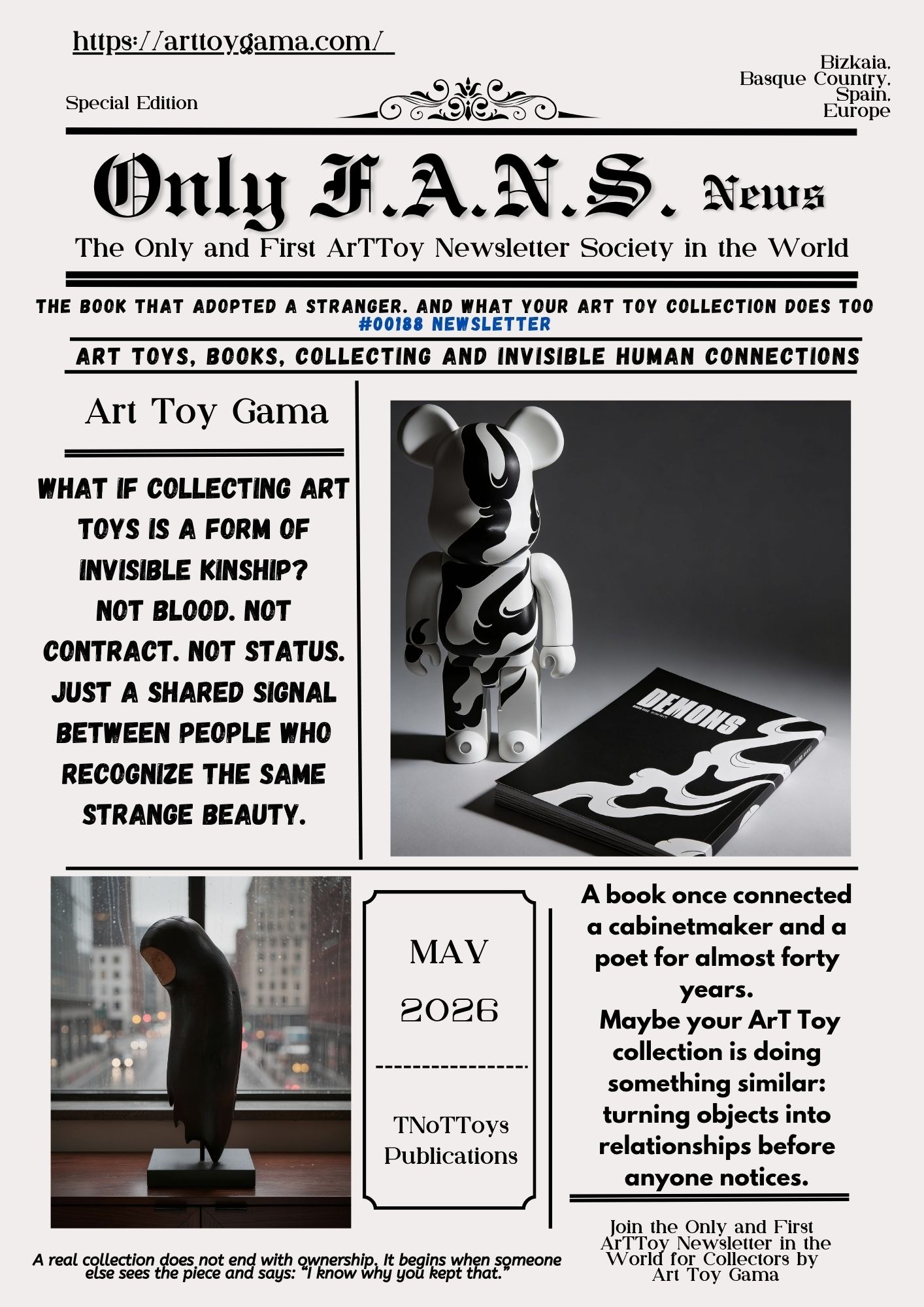
The Book That Adopted a Stranger; and Your ArT Toys Too
ArT Toys and Book stories about collecting, memory, invisible human connections, strangers, artists and real Dis(Play) culture. ArT Toy Gama Newsletter #188
ART TOY NEWSLETTER
Sergio Pampliega Campo & Cristina A. del Chicca
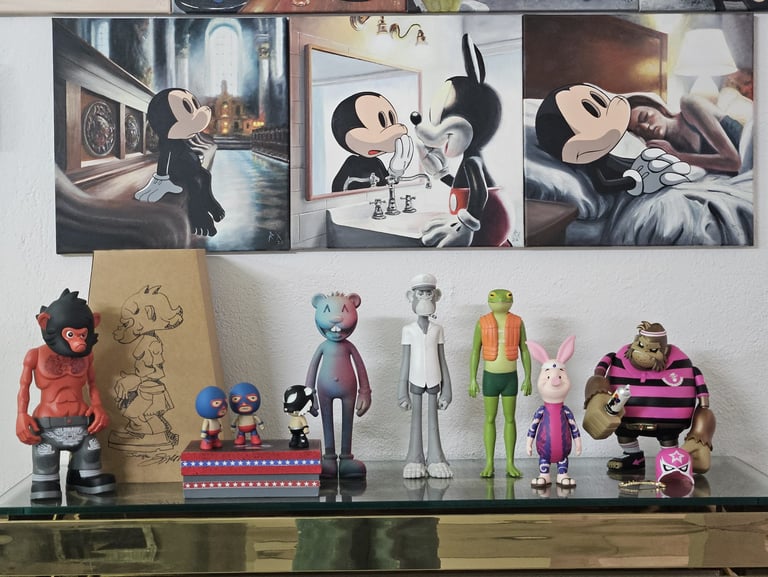
Subject: A cabinetmaker took care of a poet for almost four decades because a book had already made them family. Maybe your ArT Toy collection is doing the same thing: building invisible bonds before you can explain them.
You think you collect objects.
You don’t.
You collect strange forms of kinship.
A book can make two strangers family.
An ArT Toy can do the same.
So can a painting.
So can a print.
Sometimes the thing you bring home
is already building a bridge
to someone you haven’t met yet.
1. The Signal Came From a Book
It started with a passage in Papyrus: The Invention of Books in the Ancient World, by Irene Vallejo.
Not about collectors.
Not about ArT Toys.
Not about drops, shelves, galleries, paintings, prints or legacy.
This time, the signal came from a book.
And from a man who decided to care for a poet
because words had already done the impossible.
They had turned a stranger
into someone worth protecting.
2. Socrates Was Wrong About Dead Words
Socrates distrusted written words.
For him, letters were pale shadows.
Dead signs.
Ghosts of the living voice.
He believed the real thing happened in conversation.
Face to face.
Voice to voice.
Soul to soul.
And maybe he had a point.
But then Irene Vallejo brings us to Friedrich Hölderlin.
A German poet.
Born in 1770.
One of those wounded, luminous figures who seemed to belong more to ancient Greece than to his own century.
Hölderlin had written Hyperion, a novel published between 1797 and 1799.
A book about beauty.
Longing.
Exile.
Revolution.
The dream of Greece.
The pain of not fitting inside your own time.
A book that did not remain trapped on the page.
Because years later, it would change the life of someone who was not supposed to matter in literary history.
A cabinetmaker.
3. The Cabinetmaker Who Let a Book Decide
Hölderlin’s life broke.
Around the age of thirty, he began to suffer severe mental crises.
His family eventually placed him in medical care.
He was considered incurable.
And then, in the summer of 1807, Ernst Zimmer appeared.
Zimmer was not a famous critic.
Not a museum director.
Not a collector with a white-glove archive.
He was a cabinetmaker.
But he had read Hyperion.
And the book had moved him.
So when he met Hölderlin, he did something almost absurd.
He took the poet into his home.
He gave him shelter.
Food.
Care.
Time.
A room by the river Neckar.
Hölderlin stayed there until his death in 1843.
Almost four decades.
No bloodline.
No contract.
No obvious benefit.
Only a book.
Only the invisible force of words
creating a bond stronger than polite obligation.
4. Your Collection May Be Doing the Same Thing
That is the part that stays.
The invisible thread.
The strange proof that an object can carry enough emotional force
to rearrange a life.
And maybe collecting works the same way.
Maybe the ArT Toy on your shelf is not isolated.
Maybe the painting on your wall is not silent.
Maybe the print inside that sleeve is not waiting to be framed.
Maybe each piece is building a private map of connections.
To the artist.
To the story.
To the person you were when you found it.
To the person who will ask about it one day.
To the collector who sees the same wound inside the same figure.
To the stranger who suddenly becomes less strange
because you both understood the same object.
A real collection does not only show taste.
It opens conversations.
Between the artist who made the wound visible
and the collector who recognized it.
Between collectors who thought they were alone.
Between a gallerist and the person who finally understands
why that piece had to be there.
Between curators, galleries, shops and artists
trying to give form to what the market still calls strange.
Between friends.
Between strangers.
Between people who had nothing in common
until one figure, one painting, one print
gave them a language.
Quietly.
Illegally.
Emotionally.
Like a book that walked into a cabinetmaker’s life
and turned a broken poet into family.
5. The Pieces You Collect Are Already Introducing You
This story came from Irene Vallejo’s Papyrus: The Invention of Books in the Ancient World.
From Socrates.
From Hölderlin.
From Zimmer.
From Hyperion.
From a book that refused to remain paper.
And it made us think:
Maybe the strongest collections are not built from objects.
They are built from invisible loyalties.
The piece you keep returning to.
The artist whose work feels like a private language.
The print you bought before you had a wall for it.
The figure that somehow explains you better than your biography.
Because what you collect can become more than evidence of what you like.
It can become evidence of who you are willing to remember.
Who you are willing to protect.
Who you are willing to talk to.
And what kind of invisible family you are building around your life.
That is why Dis(Play) matters.
Because a collection is never just between you and the object.
There is always someone else hidden inside.
The artist.
The maker.
The future viewer.
The next collector.
The stranger who sees it and says:
“I know why you kept that.”
And suddenly, the room changes.
Discover ArT Toys, paintings and fine art prints created for those who refuse to collect empty objects.
Explore the Art Toy Gama Shop.
And start building a collection that does more than decorate.
Let it connect.
Let it remember.
Let it introduce you
to the strangers who were always meant to find you.
Art Toy Gama
Where Dis(Play) becomes Memory.
Want to know much more about this Story...? Link Here
(You can read also POST BLOG:
Friedrich Hölderlin, ArT Toys and Silent Bonds
ArT Toy Newsletter #44)
📍 Join the First and Only Art Toy Newsletter Society in the World here: https://emails.arttoygama.com/l/email-subscription
This email was originally sent to the Newsletter subscriber list on May 28, 2026
Tuesdays 16:12. Thursdays 17:47. Sundays 18:32.
3 times a week, we don’t send a Newsletter.We jam the signal.
Art Toys. Paintings. Fine Art Prints. Not what you expect.
Real collectors don't follow trends—they redefine them
We didn’t lose our inner child. We turned it into Art.
You collecting, or just hoarding what the algorithm spoon-feeds you?
contact
© 2025. All rights reserved.