We didn’t lose our inner child. We turned it into ArT Toys and More...with purpose.
Touma! Touma! Touma!: When a Knucklebear Wore a Zero-Sen
An Eastern artist landing in Pasadena. The 2005 Pasadena Touma! Touma! Touma! Exhibition That Turned Uncertainty Into Legacy #00007 — TNoTToys Publications
1000 ICONIC ART TOY EXHIBITIONSTNOTTOYS PUBLICATIONSTNOTTOYS
Sergio Pampliega Campo & Cristina A. del Chicca
🌀 This post is part of an ongoing research series from Art Toy Gama’s editorial division:
📚 This Is Not a Book About Art Toy Exhibitions & ToyCons
Our Upcoming Art Toy Book: 1000 Iconic ArTToy Exhibitions
1. Context Matters — Pasadena, 2005
December 10, 2005.
36 W. Colorado Blvd. #5, Pasadena, California.
While the Art world was still busy arguing whether “Designer Toys” were Toys or Art, mixi-bang! quietly staged something else entirely: a cultural landing. A Japanese artist named Touma brought his universe of beasts, balloons, and misfit heroes into a small American shop and, without asking permission, rewrote part of the Art Toy genome.
No press conference, no museum budget. Just a local gallery, a Saturday night reception at 7 PM, and a single word repeated three times like a code:
TOUMA. TOUMA. TOUMA.
It read like an echo of “Tora! Tora! Tora!”: the phrase that once signaled attack.
Only this time, the invasion wasn’t military.
It was mythological.
2. POSTER Reading I: Aniballoon Crossbone & the Underground Invitation
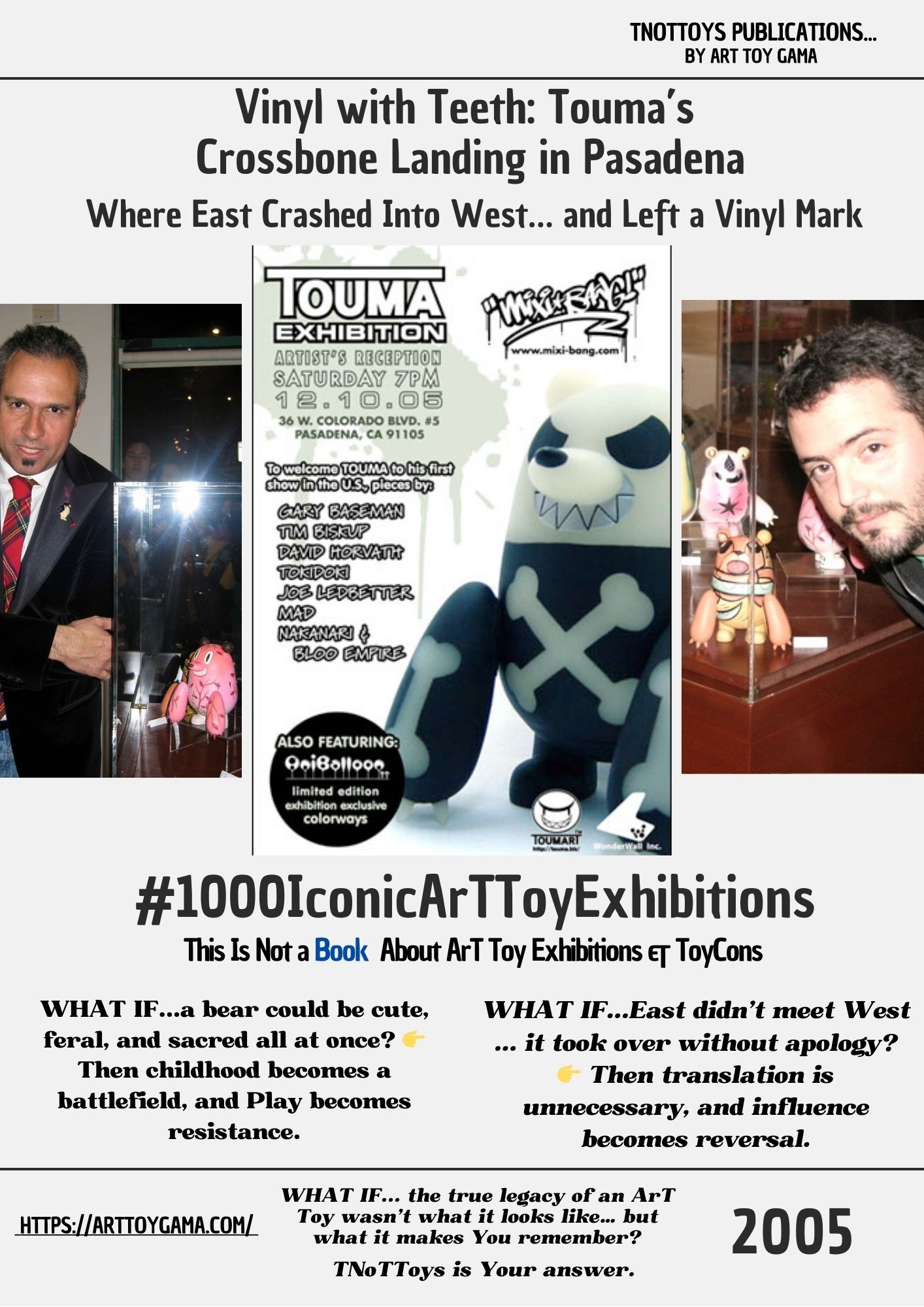
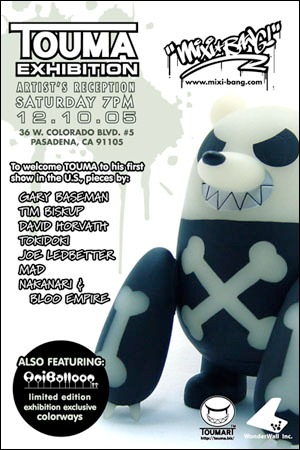
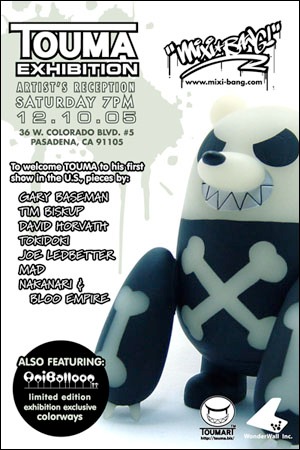
The first POSTER feels like a back-alley signal more than a polished ad. It’s a vertical freeze frame: the Aniballoon Crossbone figure in the foreground, illuminated like a product shot, yet charged with something darker.
Visual Core
A mostly monochrome palette, blacks, greys and desaturated teal, that makes the pale vinyl pop.
The figure’s body is soft and bulbous, but its expression is razor sharp: jagged teeth, hollow eyes, and bones arranged in an X across the chest.
At the bottom, three small logos: TOUMART, Wonderwall, and mixi-bang!, quietly reveal the ecosystem that made this invasion possible.
Here the black-and-white intensity matters.
It pushes the image away from the friendly, candy-colored codes of most ArT Toys and straight into the territory of hardcore or punk concert flyers.
The POSTER positions the Exhibition not as a polite art event, but as a noisy, defiant subculture moment.
The crossbone on Aniballoon’s chest behaves like a warning label.
Danger. Rebellion. Piracy.
The figure looks less like a product and more like a bootleg from Touma’s imagination; a reminder that this kind of ArT Toy is “pirated” from dreams, not licensed from brands.
Typography & Hierarchy
• “TOUMA EXHIBITION” sits at the top in bold, blocky type, stacked like a club-night announcement.
• Below it, the functional data:
“Artist’s Reception Saturday 7 PM 12.10.05 – 36 W. Colorado Blvd. #5 – Pasadena, CA 91105.”
Practical, compressed, almost breathless.
• The left column lists the guest artists in simple uppercase:
Gary Baseman, Tim Biskup, David Horvath, Tokidoki, Joe Ledbetter, MAD, Nakanari, Bloo Empire.
It reads like a who’s-who of early Western vinyl: a roll call printed in the same space as Touma’s creature, as if they’re all stepping into his world, not the other way around.
That block of names isn’t just credit.
It is structural.
It shows that the Exhibition rests on a collective base, and that Touma is not a solitary genius but a catalyst.
Aniballoon is the starting point, but the real power of the Show lies in how many hands it passes through.
The POSTER declares that the greatest strength of the ArT Toy Movement is its capacity to act as a democratic canvas where East and West, Pop and Lowbrow, can mutate together.
The typography doesn’t try to look “museum.”
It looks like a flyer for an underground show, photocopy-ready, tuned for hands and telephone poles, not white cubes.
Composition & Atmosphere
The figure occupies the lower right, leaning forward, cropped at the feet. The negative space above is loaded with text: a classic gig-POSTER move. Information and idol share the same oxygen.
The result is a tension between corporate clarity (logos, sponsors, clear venue info) and subcultural energy (pirate bones, sharp teeth, a Toy that looks like it might bite back).
The POSTER whispers one message:
“This is not just a product drop.
This is a meeting point of worlds.
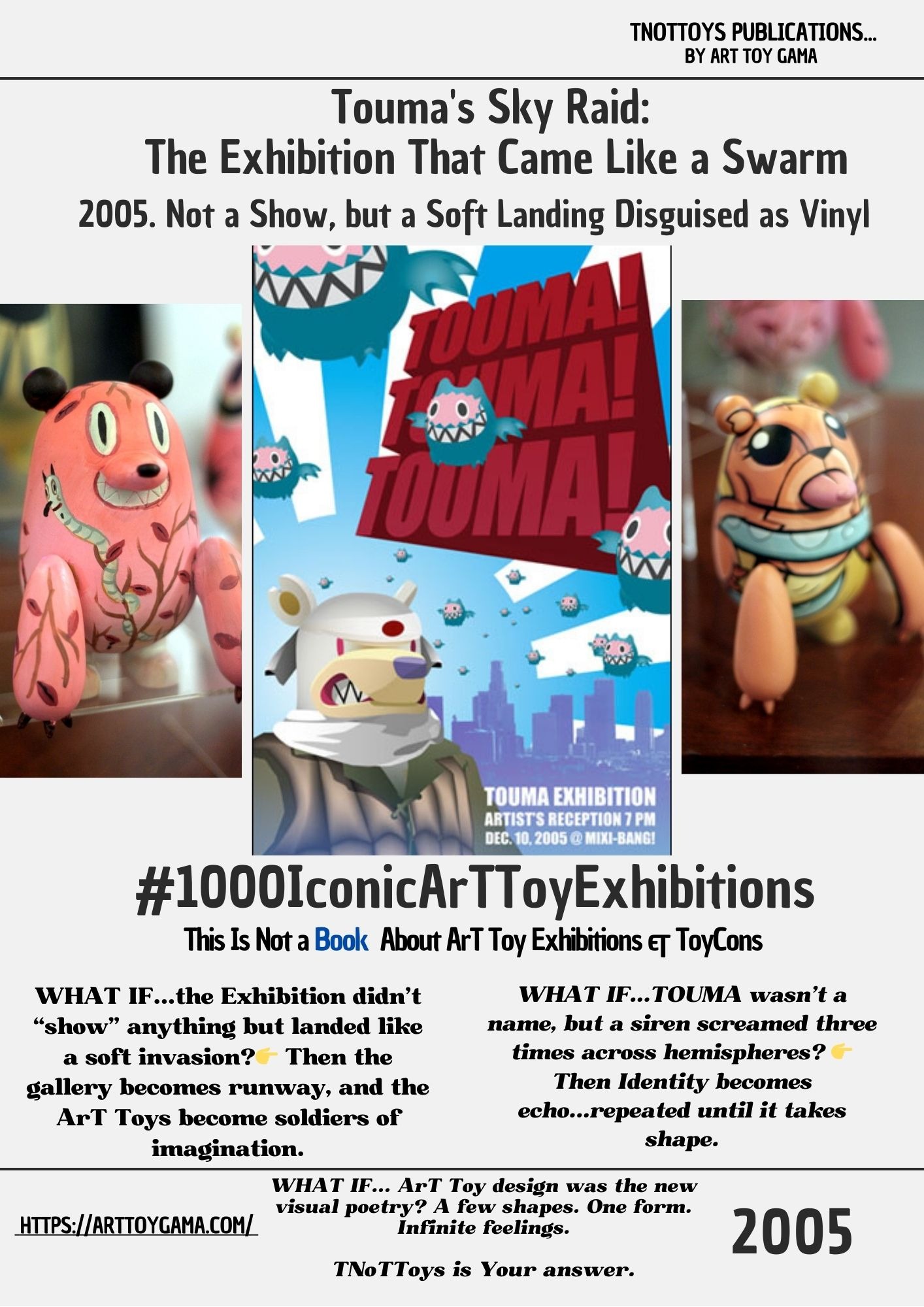
3. POSTER Reading II: TOUMA! TOUMA! TOUMA! & the Aerial Invasion
The second POSTER abandons understatement entirely.
Where the first behaves like a flyer, the second behaves like a banner.
Visual Explosion
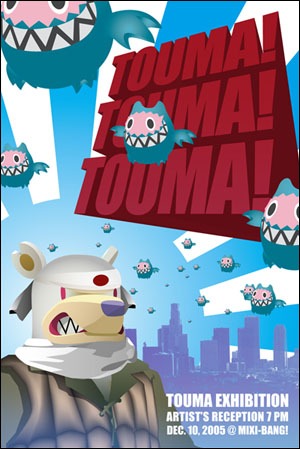
• The sky is flat blue, sliced by white rays, echoing both manga speed lines and retro propaganda posters.
• Across the center, the word TOUMA! is repeated three times in towering red letters, stacked and slightly skewed, like a shouted name reverberating through the sky.
• A swarm of Baboo creatures — turquoise bodies, pink faces, sharp little teeth — fly in every direction, turning the air into an animated battlefield.
• At the bottom, the Pasadena skyline is reduced to blocky silhouettes, tinted purple-blue. The city becomes stage set.
Read as a whole, the composition feels like an airstrike of characters.
The Baboo swarm doesn’t just decorate the background; it moves like a takeoff pattern.
They function as a support squadron around the Knucklebear pilot, reinforcing the idea of an aerial assault — not on territory, but on imagination and market share.
And then, anchored in the foreground:
Knucklebear wearing a Zero-Sen pilot helmet, scarf blowing, shoulders squared, the posture oddly heroic and strangely melancholy.
This isn’t the smug streetwise Knucklebear we know from other releases.
This one looks like a soldier from another era who wandered into a graphic novel.
Typography as Siren
• The triple “TOUMA!” in red is the loudest element in the entire composition.
• At the bottom, in clean sans serif, the practical line:
“TOUMA EXHIBITION — ARTIST’S RECEPTION 7 PM — DEC. 10, 2005 @ MIXI-BANG!”
Small, almost humble under the giant name above it.
The hierarchy is clear:
1. First, you see the name.
2. Then, you feel the swarm.
3. Only at the end do you realize there’s a reception you could physically attend.
That repetition of TOUMA three times is not only a war-code echo.
It is aggressive branding stripped to the bone.
In a landscape flooded with information, redundancy becomes a weapon: the name hits your eyes three times before anything else.
The message is simple and fearless: this isn’t “a Toy show.”
It is Touma.
The POSTER doesn’t invite You.
It warns you: Touma is arriving, and he’s not arriving alone.
Symbolic Reading
Knucklebear in a Zero-Sen helmet is a loaded image.
It compresses:
• Japanese wartime history
• aviation myth
• cartoon aesthetics
• and contemporary vinyl culture
…into a single silhouette.
The Zero-Sen itself is a dual symbol.
It carries the pride of Japanese engineering and technological prowess,
but also the memory of imperial aggression and defeat in World War II.
By placing that helmet on a vinyl bear, Touma twists the meaning.
The new “Zero-Sen mission” is not military, but cultural.
The conquest is no longer about territory; it’s about aesthetics, storytelling and market imagination.
Art becomes the new front line.
Knucklebear is also a hybrid.
A bear is a familiar figure in Western childhood culture: plush, safe, comforting.
Dress it in a Japanese fighter pilot’s uniform and you get a creature that is both familiar and foreign, playful and solemn.
That uneasy hybrid perfectly captures the friction of the Exhibition: East meeting West, cute meeting dangerous, toy meeting history.
Instead of glorifying war, the image absorbs that history and neutralizes it through absurdity.
A bear in a pilot helmet, surrounded by pastel sky and chewing-gum-colored monsters, turns conflict into playable narrative.
In the Art Toy Gama lens, this is exactly what we mean by:
The absurd as language,
the emotional as memory,
the small act as revolution.
4. The Energy Behind the POSTERS:
Identity, Nostalgia, Rebellion, Legacy
Identity
• POSTER 1 frames Touma as part of a wider constellation (Baseman, Biskup, Ledbetter & co.), an artist entering a Western scene with respect but without dilution.
• POSTER 2 flips it: Touma’s name dominates the sky. The city shrinks. His characters don’t visit Pasadena; they own it for one night.
Together they tell a story of an artist who is both community and brand.
First among peers.
Then, name above city.
Nostalgia
• The Zero-Sen reference and the “Tora/Touma” echo summon historical memory without reenacting it.
• The visual language evokes old movie posters, retro anime, and playground fantasies of dogfights and monsters in the sky.
Rebellion
• Both POSTERS refuse neutral design.
• Crossbones, swarms, bold colors, and helmeted bears reject the idea that an art exhibition poster must be polite.
• They sit closer to punk flyer and imported manga cover than to gallery mailer.
Legacy
These POSTERS are not ephemera.
They function as cultural artifacts: the kind of print that belongs in the very book we’re building: This Is Not a Book About Art Toy Exhibitions & ToyCons – #1000IconicArTToyExhibitions.
They don’t just say “come to the show.”
They say, “Remember this moment. You’ll need it later.”
5. What the Exhibition Showed: Tables, Creatures, and Micro-Rituals
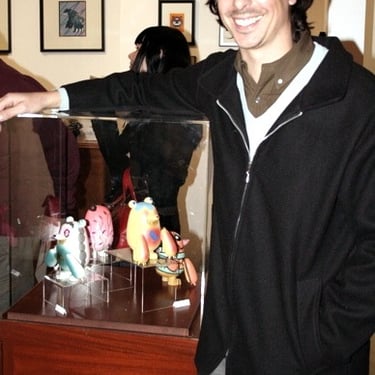
Inside mixi-bang!, the installation wasn’t monumental.
It was dense.
• Shelves and tables lined with Knucklebear, Aniballoon, Skuttle, Hell Hound and more.
• Exclusive colorways produced specifically for the event.
• Glow-in-the-dark variants and one-off customs.
• A rumored dragon prototype that whispered toward futures yet to be sculpted.
• Prints and original sketches providing the 2D DNA of the creatures.
But the real artwork was the interaction:
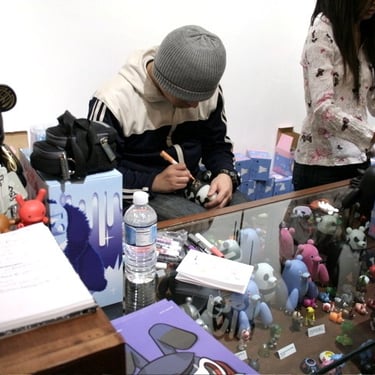
Each time someone bought a piece, Touma took it, uncapped a pen, and drew directly on the vinyl.
A signature, a doodle, a new expression, a tiny scar on the surface.
The Toy that left the shop was no longer the toy that arrived.
The live sketch ritual turned ownership into intimacy. And the ArT Toy became memory, not merchandise, altering how collectors interacted with ArT Toys.
This is where the philosophy of TNoTToys and Art Toy Gama becomes tangible: publishing and posters as records of experience, and collecting as an active, emotional ritual rather than passive possession.
This wasn’t retail.
It was Dis(Play) in its purest form:
the moment where buying and belonging become the same Act.
6. The Lineup. From Tokyo to Pasadena
The Exhibition wasn’t a solo monologue.
It was a chorus.
Guest artists like Gary Baseman, Tim Biskup, Joe Ledbetter, Tokidoki, MAD, Nakanari, Bloo Empire, and a custom painting by David Horvath all reinterpreted Touma’s visual vocabulary.
Aniballoon became a platform:
• In Baseman’s hands, it leaned toward pop-surreal confession.
• In Ledbetter’s, toward bold cartoon geometry.
• In Tokidoki’s, toward graphic, logo-driven cuteness.
Each custom piece was a new dialect spoken through the same body.
This was early proof that the ArT Toy-as-canvas idea was not theory but living practice: a model of collaboration that would echo across the next decade of exhibitions and brand partnerships.
One ArT Toy in particular, the Aniballoon Crossbone, later slipped into a Transformers film: a tiny yet powerful example of how a piece born in a small Pasadena shop can infiltrate global pop culture.
The Crossbone POSTER makes that logic visible.
By stacking the Western “heavyweight” names right under Touma’s creature, it states that the Exhibition’s real power lies in the collective.
Touma provides the base form; the community mutates it.
The ArT Toy is presented not as a fixed object, but as an open, democratic canvas able to host voices from East and West under a single mutant standard.
7. Biography in Brief. Who Is Touma?
Touma (b. 1971) spent nearly a decade designing video games before stepping out as an independent artist in the early 2000s.
His work fuses:
• the immediacy and exaggeration of Japanese manga,
• the angular energy of Western graffiti,
• and the sensibility of character design as myth-making.
His breakout came with Knucklebear, the first of his characters to be produced as a vinyl figure, establishing a visual language of hunched posture, thick limbs, and expressive muzzles recognizable at a glance.
Then came Skuttle, Aniballoon, Hell Hound and others, each oscillating between feral and adorable, threat and Toy, talisman and mascot.
For Touma, the ArT Toy isn’t a static sculpture.
It’s a narrative device.
Aniballoon, for instance, behaves as “a dream turned into a balloon”: sometimes goofy, sometimes menacing, always charged with story.
This is what artists like Touma brought to the early ArT Toy Movement:
not objects, but worlds.
8. Why It Mattered: East → West (and Back Again)
This Show wasn’t a routine calendar entry.
It was cultural translation in real time.
• A Japanese artist entering the American scene on his own terms.
East met West with no compromise.
No smoothing the edges.
No adapting for the market.
Touma spoke in beasts and balloons,
and Pasadena understood.
• A small Shop proving it could operate as a cultural gateway, not just a retail space.
• ArT Toy Collectors discovering that the “transaction” could include a drawing, a handshake, a story, not just a receipt.
Exhibitions like this validated the idea that:
• A Toy could be a canvas.
• A POSTER could be an artifact.
• A queue outside a tiny Gallery could be the seed of a global Movement.
In other words, Touma! Touma! Touma! helped shift ArT Toys from “cool items to buy” to experiences that shape how you remember yourself.
Asia → America: The Inversion of Influence
The Pasadena landing also marks a deeper shift.
For once, the cultural flow did not move only from West to East.
It moved the other way.
Artists and brands like Touma, Michael Lau or Bounty Hunter weren’t just exporting products.
They were exporting a new design syntax and a new business model: limited drops, short-run editions, collaborative releases as events.
Touma’s Zero-Sen pilot is part of that statement.
The old symbol of Japanese power is repurposed as metaphor: the new “assault” on the West comes through concepts, not carriers.
Asia, especially Japan and Hong Kong, positions itself as the source of aesthetic innovation: hard-edged Urban Vinyl, mutated Chibi and Kawaii, toy bodies that behave like moving sculptures.
When that language collides with Western gallery culture and collector mentality, the toy is pushed upward into the realm of limited-edition art.
At the same time, the production platforms themselves, from custom bases to blind-box series, create a two-way bridge.
Figures manufactured under an Asian model invite Western Lowbrow, Street Art and Pop Surrealist artists to join in, turning the whole scene into a transnational collaboration engine.
Even the business mechanics travel.
Gachapon logic, surprise capsules, planned scarcity, the thrill of chance, mutates into the blind box systems popularized by Kidrobot and others.
Hype, scarcity and ritualized unboxing become economic fuel for the Movement, and all of it is rooted in that Asia-to-America transfer.
9. Legacy & Mutation: From Swaggering Beast to Icon
Looking back from the vantage point of Art Toy Gama, this exhibition reads like a genesis Story for several key truths in the ArT Toy Movement:
• Characters as Totems
Knucklebear and Aniballoon transcended character status and became totems: shorthand for a certain kind of hybrid, playful, slightly dangerous vinyl energy that defined the 2000s.
• POSTERS as Memory Devices
The two Exhibition POSTERS now function like time capsules: they don’t just recall an event; they encode the emotional weather of the scene in 2005.
• Shops as Cultural Agents
mixi-bang! wasn’t just a venue. It acted as a micro-museum and community hub, aligning with the way TNoTToys and Art Toy Gama understand shops, galleries, and ToyCons: not sales points, but stages for Dis(Play).
• The Collector as Co-Author
Through Touma’s live drawing ritual, ArT Toy collectors didn’t just take home objects; they took home co-authored memories.
Knucklebear didn’t remain a swaggering beast.
It became punctuation in the vinyl sentence of the 2000s,
an exclamation mark at the end of a decade that turned toys into a serious, if playful, visual language.
The Asia–America connection forged here proved structural, not decorative.
It showed that the ArT Toy could be a shared language across continents almost from day one: a platform where communities, markets and mythologies on both sides of the Pacific could mutate each other in real time.
🎯 Final Thought. From Art Toy Gama
This Exhibition leaves us with a liberating conclusion:
An ArT Toy is a tool of translation.
It translates:
• cultures into characters,
• doubt into legacy,
• a collector’s queue into a personal myth worth retelling.
At Art Toy Gama and TNoTToys, we name it clearly:
If a bear in a Zero-Sen helmet could transform a moment of professional uncertainty into a lasting legacy,
then your ArT Toy collection can transform your own doubts into narrative.
Because when we trace the path of shows like Touma! Touma! Touma!,
we see it plainly:
We’re not buying plastic.
We’re buying chapters.
And some chapters, like that night in Pasadena in 2005,
keep writing themselves long after the doors close.
🎯 Explore the Art Toy Gama Store ...
Join The First and Only Art Toy Newsletter Society in the World here: https://emails.arttoygama.com/l/email-subscription
#1000IconicArTToyExhibitions
We’re currently building an Upcoming Publication that explores and celebrates
the most iconic and influential Art Toy exhibitions around the world.
Each article in this series helps document, reflect, and invite the community
to take part in constructing this cultural archive — one exhibition at a time.
We’ve seen countless exhibitions since then: small and large, modest and monumental.
And we love them all.
No matter where they take place or the resources behind them,
every ArT Toy show adds something to the Movement.
Some will make history, others will make Memory. All of them matter.
This is not just documentation.
This is Dis(Play) in the making.
And You’re part of it.
Art Toy Gama Legacy
#ArTToyGamaLegacy
Art Toys. Paintings. Fine Art Prints. Not what You expect.
Real collectors don't follow trends—they redefine them
We didn’t lose our inner child. We turned it into Art.
You collecting, or just hoarding what the algorithm spoon-feeds you?
contact
© 2025. All rights reserved.