We didn’t lose our inner child. We turned it into ArT Toys and More...with purpose.
Sank Toys: ArT Toys, Memory, Emotional Collecting & DisPlay
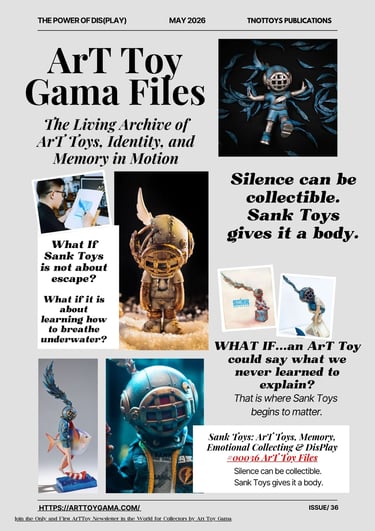
A reflection on Sank Toys, emotional collecting, identity, visual culture, and why some ArT Toys are really living forms of Dis(Play) #00036 ArT Toy Files
ART TOY GAMA INSIDEART TOY FILESTHE LIVING COLLECTION
Sergio Pampliega Campo & Cristina A. del Chicca
Uncovering the Stories, Creators and Culture Behind #ArTToys
An Art Toy Gama Perspective
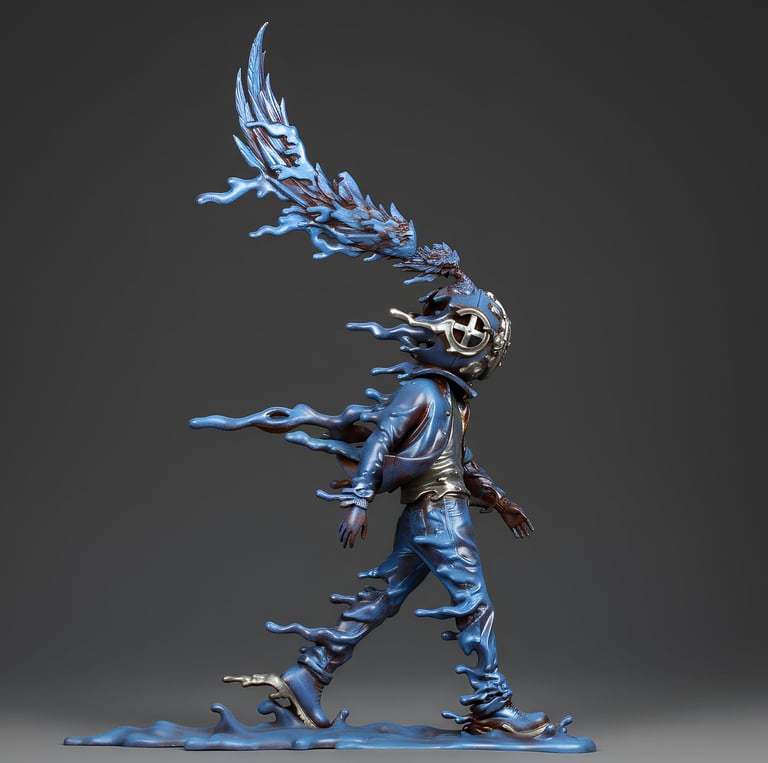
This is not just a child with a helmet.
This is what happens when memory tries to survive pressure.
Sank Toys doesn’t attack you.
It doesn’t kick the gallery door open like KAWS.
It doesn’t turn repetition into ritual like Be@rbrick.
It doesn’t sell you cuteness polished for the algorithm.
Sank does something quieter.
And maybe more dangerous.
It waits.
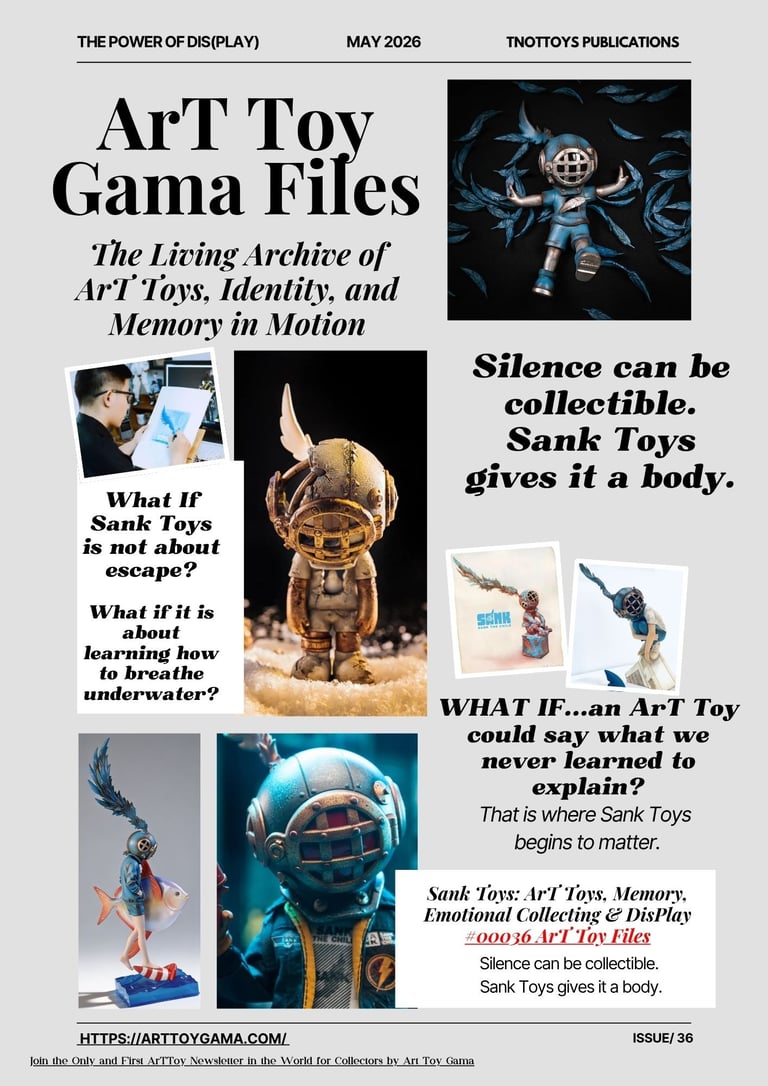
Its most recognizable visual universe — small bodies, diving helmets, wings, soft melancholy, fragile tension — does not behave like ordinary collectible design.
It behaves like a memory you almost managed to bury.
A child with a helmet.
A pair of wings that may never fly.
A body caught between sinking and escaping.
That contradiction is not decorative.
It is the wound.
Because Sank Toys seems to understand something many brands, galleries, collectors, and even ArTists sometimes forget:
the most powerful ArT Toy is not always the one that screams rebellion.
Sometimes it is the one that whispers:
“You survived.
But you still remember.”
Sank Toys and the emotional architecture of contradiction
At ArT Toy Gama, we don’t see ArT Toys as ornaments.
We see them as emotional devices.
Memory engines.
Identity capsules.
Tiny insurgencies against the dictatorship of empty taste.
But that does not mean every object automatically becomes profound.
Depth is not granted by vinyl.
Nor by scarcity.
Nor by sadness.
Nor by the word “art” placed near a toy.
Depth has to be earned.
And Sank earns it through contradiction.
The helmet protects.
But it also isolates.
The wings suggest freedom.
But they also expose the distance between desire and escape.
The child looks innocent.
But the silence around him feels old.
This is where Sank becomes more than design.
It becomes emotional syntax.
A visual language for people who know what it means to keep going while carrying things they cannot fully explain.
For collectors, Sank is not just another figure on the shelf.
It can become a mirror with soft edges.
For ArTists, it is proof that vulnerability can become form.
That a figure does not need aggression to carry force.
For curators and galleries, Sank opens a door into a more intimate territory of the ArT Toy Movement: one where vinyl, resin, limited editions, and sculptural characters stop behaving like inventory and start behaving like emotional testimony.
For brands, Sank is a warning.
The future of desire is not only hype.
It is resonance.
And for anyone who has ever felt too sensitive for this world, Sank suggests something almost unbearable:
maybe you were never weak.
Maybe you were just underwater.
The diving helmet is not nostalgia. It is survival equipment.
People may look at Sank and say:
“How poetic.”
“How cute.”
“How dreamy.”
But that reading is too easy.
And easy readings are where meaning goes to die.
The diving helmet is not merely a vintage accessory.
It is survival equipment.
It says: you can enter pressure and still breathe.
You can descend into memory and not disappear.
You can carry loneliness without letting it become your prison.
That is why Sank feels contemporary.
Not because it follows a trend.
But because it touches an emotional climate many people recognize: a generation trained to perform wellness while quietly drowning inside productivity, screens, expectations, and curated happiness.
Sank does not fake optimism.
It does not sell the cheap fantasy of escape.
The wings are there, yes.
But they do not promise flight.
They suggest something more honest:
the desire to rise, even when gravity still owns part of you.
And that is where the ArT Toy becomes powerful.
Not when it decorates a shelf.
But when it names a tension you had been carrying without language.
Sank Toys and the silent evolution of contemporary Asian visual culture
For too long, Western eyes have flattened Asian visual culture into obvious symbols.
Dragons.
Lanterns.
Porcelain.
Neon cities.
Cute mascots.
Mythic monsters.
But Sank Toys does not fit that lazy postcard.
It belongs to another frequency.
Softer.
Stranger.
More internal.
Sank feels connected to a broader emotional language emerging from contemporary Asian creativity: one that does not need to shout tradition in order to carry cultural depth.
It replaces spectacle with intimacy.
It does not perform identity.
It metabolizes it.
This is not the heroic East.
Not the ornamental East.
Not the exotic East packaged for Western consumption.
This is something more private.
The anxious interior.
The poetic bruise.
The generation that grew up hyperconnected, hyperproductive, and emotionally overcompressed.
Where Xiaomi might engineer elegance into technology, Sank engineers silence into collectible form.
Where Apple turns devices into extensions of the self, Sank turns ArT Toys into confession booths.
Where Studio Ghibli gives melancholy a landscape, Sank gives it a helmet and wings.
And suddenly, the figure is no longer just a boy.
It becomes a question:
What if the future of ArT Toys is not louder, bigger, or more spectacular?
What if it is deeper?
Dis(Play): when the shelf stops being furniture and becomes autobiography
Here is the mistake most people make.
They think displaying an ArT Toy means placing it somewhere visible.
Wrong.
That is display.
Dis(Play) is different.
Dis(Play) is what happens when an object stops being passive and starts speaking on your behalf.
It is the moment your shelf stops being furniture and becomes autobiography.
It is the moment a collector stops asking only, “What is this worth?” and starts asking, “Why does this feel like me?”
Sank Toys belongs in that territory.
Not because it is automatically sacred.
Not because every edition, colorway, or release must be treated as revelation.
But because its strongest pieces activate something deeper than possession.
They ask to be read.
Not just owned.
They ask to be lived with.
Not just photographed.
They ask to be Dis(Played).
Because to Dis(Play) Sank is to admit something:
that you value tenderness without weakness.
that you understand silence as language.
that you collect not only beauty, but emotional evidence.
And that matters.
Because the ArT Toy Movement was never just about Toys.
It was always about giving form to identities that traditional ArT systems did not know how to hold.
Too playful for museums.
Too emotional for design.
Too collectible for fine ArT.
Too strange for mass taste.
Good.
That is where movements begin.
Not in comfort.
In friction.
Why Sank is not merely a product, but a living emotional manifesto
The old ArT world still wants categories.
Toy or sculpture?
Collectible or ArTwork?
Design object or emotional artifact?
Commercial product or cultural statement?
Sank answers by refusing to stay inside one box.
That refusal is its strength.
Because Sank Toys does not need to solve the contradiction.
It embodies it.
Helmet and wings.
Protection and exposure.
Childhood and adult anxiety.
Stillness and escape.
Silence and confession.
This is exactly why ArT Toys matter.
They allow contradiction to exist physically.
You can hold it.
Display it.
Collect it.
Curate it.
Place it in a gallery, a shop, a home, a fair, a studio, a private collection.
And suddenly, what looked small becomes serious.
Not serious in the old academic sense.
Serious because it carries memory.
Serious because it activates identity.
Serious because it gives collectors, ArTists, brands, galleries, shops, and curators a new language for what cannot be reduced to canvas, sculpture, fashion, or toy industry logic.
At ArT Toy Gama, we believe the true power of ArT Toys is not only that they blur categories.
It is that they expose how fragile those categories were in the first place.
Sank doesn’t teach you how to fly.
It teaches you how to remain visible while sinking.
That may be the most beautiful thing about Sank Toys.
It does not rescue you.
It does not give you a superhero fantasy.
It does not pretend the world is light.
It does not remove the pressure.
It gives the pressure a body.
And once something has a body, you can face it.
You can collect it.
Curate it.
Dis(Play) it.
Turn it into memory instead of letting it become fog.
That is why Sank Toys belongs in the deeper conversation around the ArT Toy Movement.
Not only as a trend.
Not only as a cute object.
Not only as another vinyl figure floating through the feed.
But as quiet proof that ArT Toys can do what the best ArT has always done:
make the invisible visible.
Sank Toys reminds us that collecting is not accumulation.
It is recognition.
Creating is not production.
It is translation.
Curating is not arranging objects.
It is arranging meaning.
And Dis(Play) is not showing what you own.
It is revealing what still lives inside you.
So maybe Sank’s wings were never meant to fly.
Maybe they were meant to prove that even underwater, something in us still reaches upward.
And maybe that is why we collect.
Not because we are trying to escape childhood.
But because some parts of childhood were never lost.
They were waiting.
Helmet on.
Wings open.
Still breathing.
Join the ArT Toy Gama Newsletter
For collectors, ArTists, brands, galleries, shops, curators, and visual rebels who know ArT Toys are not decoration.
They are Memory in motion.
Discover ArT Toys, Fine ArT Prints, and Paintings made to be collected, curated, and Dis(Played) as living identity.
Because we don’t sell toys.
We share signals.
We collect memory.
We Dis(Play) what refuses to disappear.
Art Toys. Paintings. Fine Art Prints. Not what You expect.
Real collectors don't follow trends—they redefine them
We didn’t lose our inner child. We turned it into Art.
You collecting, or just hoarding what the algorithm spoon-feeds you?
contact
© 2025. All rights reserved.