We didn’t lose our inner child. We turned it into ArT Toys and More...with purpose.
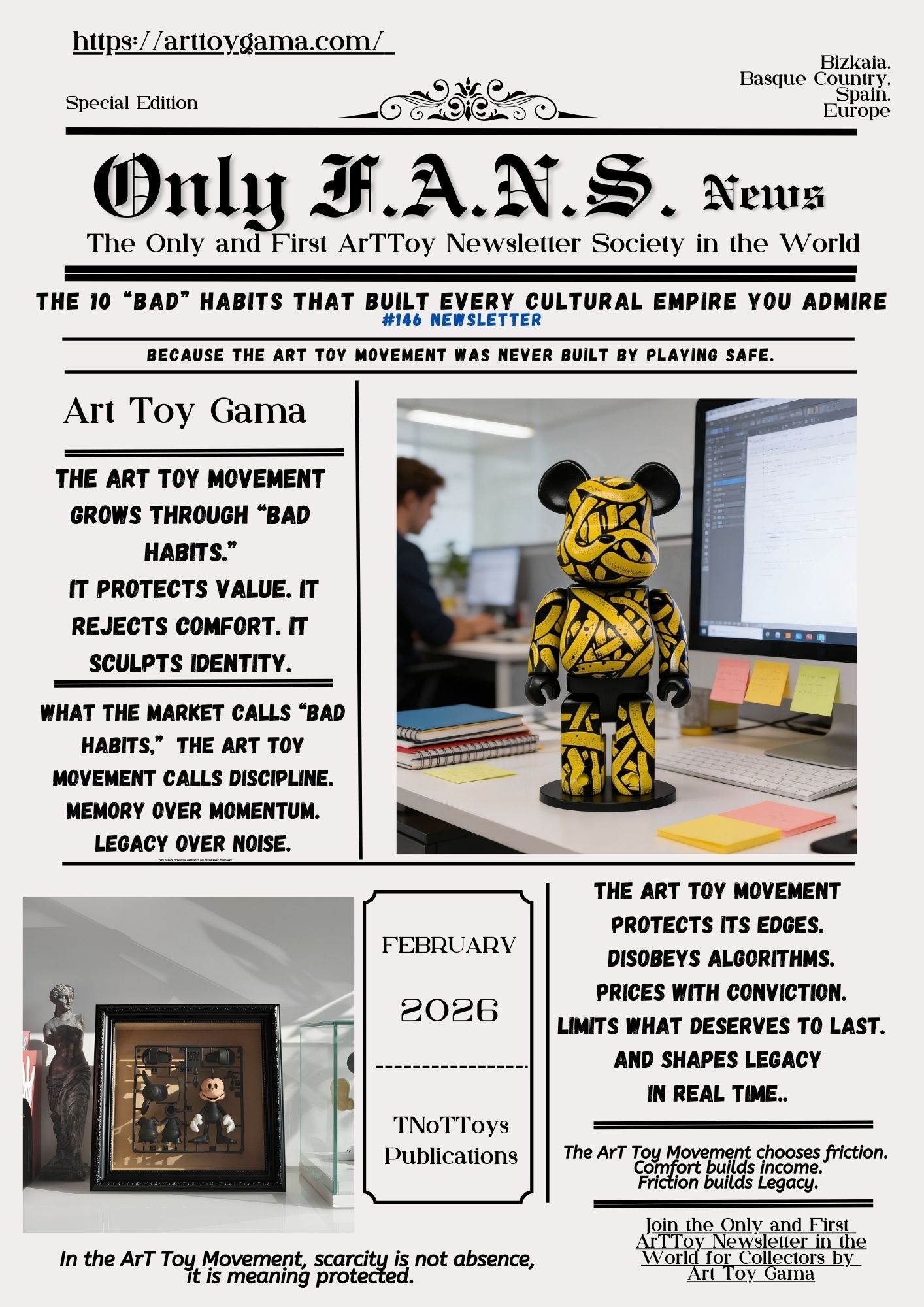
(The 10 ArT Toy Bad Habits That Build Movements)
Because the Movement was never built by playing safe... 10 ArT Toy Bad Habits That Make People Uncomfortable. ArT Toy Newsletter by Art Toy Gama #00146
ART TOY NEWSLETTER
Sergio Pampliega Campo & Cristina A. del Chicca
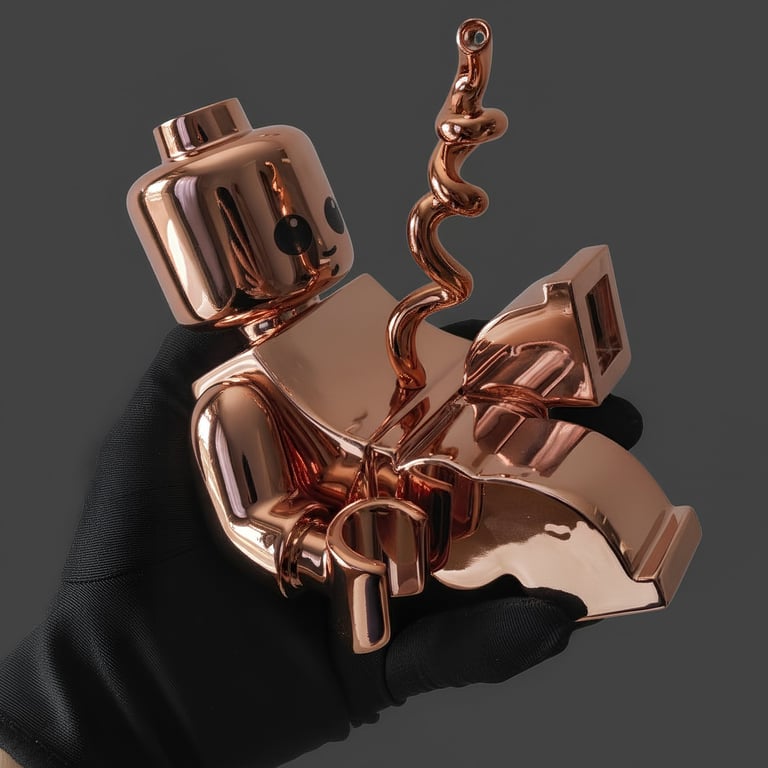
Subject: Because the Art Toy Movement was never built by playing safe.
Comfort protects income. Friction builds legacy.
Bad sellers love comfort.
Great Movements love friction.
And if you really want to understand why the ArT Toy Movement still makes some people nervous…
look at what terrifies average minds.
Because what scares them…
builds Legacies.
1️⃣ Personalization is “too much work.”
Like Netflix personalizes every feed.
Like Spotify builds your emotional algorithm.
Like Nike tells your story, not theirs.
In ArT Toys?
You don’t sell objects.
You mirror Identity.
Collectors don’t want inventory.
They want recognition.
2️⃣ Sending proposals feels pushy.
Apple didn’t wait for permission.
Supreme doesn’t restock.
Sotheby’s doesn’t apologize for the hammer price.
In this Movement, a drop is not a product.
It’s a cultural moment.
If you don’t propose meaning,
the algorithm will propose mediocrity.
3️⃣ Saying the price too soon is “risky.”
Chanel doesn’t whisper discounts.
Louis Vuitton doesn’t justify leather.
BMW doesn’t explain emotion per kilometer.
Price is not cost.
It’s positioning.
In ArT Toys, value is Memory density per square inch.
4️⃣ Don’t insist. Don’t follow up. Don’t disrupt.
Amazon insists.
Tesla insisted.
Banksy insists every time a wall breathes.
Movements are not built by politeness.
They are built by repetition with purpose.
Collecting is not a transaction.
It’s an awakening.
5️⃣ “Don’t build a voice. Just sell.”
LEGO didn’t just sell bricks; it sold permission to imagine.
Disney didn’t just sell movies; it sold nostalgia you can live inside.
NVIDIA didn’t just sell chips; it sold the next reality before it was obvious.
In the ArT Toy Movement, a voice is the difference between:
a shop… and a sanctuary.
a drop… and a ritual.
a “product”… and Living Memory.
Most galleries and stores don’t need to shout.
They just need to stand for something…consistently.
Because Dis(Play) isn’t decoration.
It’s Identity, Memory, Legacy… with teeth
Here’s the annoying part (for all of us):
If collectors, artists, galleries, shops, and curators
did just 10% more of the brave stuff…
,including us, obviously,
— personalize like Netflix (but with soul)
— protect value like Chanel (without the snobbery)
— tell story like Apple (simple, sharp, human)
— build culture like Supreme (meaning > resale)
— ignore the algorithm like Banksy ignores permission
…this Movement wouldn’t just grow.
It would hit harder.
And yeah: comfort is seductive.
But comfort builds nothing.
Friction builds Movements.
You’re not here to “buy ArT Toys.”
You’re here to choose what deserves space in your life.
So here’s a tiny challenge for today:
Pick one piece (from anyone) and ask:
Does it carry Memory… or just paint?
Does it say “you”… or just “trend”?
If you want, we’ve got pieces that hit that nerve,
and we write about this stuff obsessively.
👉 Browse the Shop (slowly).
👉 Read the Blog (with your guard down).
And if you end up buying from another gallery, another artist, another shop?
Good.
As long as your Dis(Play) means something.
That’s the whole point.
And by the way…
We only covered half of the “bad habits.”
The other five? Read: HERE
They’re even more uncomfortable.
See you in Part II.
That’s it. Clean. No drama. Curiosity planted.
And don´t forget to read this: 10 ArT Toy Dangerous Habits That Build Legacy
📍 Join the First and Only Art Toy Newsletter Society in the World here: https://emails.arttoygama.com/l/email-subscription
This email was originally sent to the Newsletter subscriber list on February 19, 2026
Tuesdays 16:12. Thursdays 17:47. Sundays 18:32.
3 times a week, we don’t send a Newsletter.We jam the signal.
Art Toys. Paintings. Fine Art Prints. Not what you expect.
Real collectors don't follow trends—they redefine them
We didn’t lose our inner child. We turned it into Art.
You collecting, or just hoarding what the algorithm spoon-feeds you?
contact
© 2025. All rights reserved.