We didn’t lose our inner child. We turned it into ArT Toys and More...with purpose.
🕯️ Friends from Forgotten Fairytales
When ArT Toys Woke Up the Monsters We Once Loved. The 2014 Kidrobot San Francisco Exhibition That Rewrote Forgotten Fairytales #00001 TNoTToys Publications
1000 ICONIC ART TOY EXHIBITIONSTNOTTOYS PUBLICATIONSTNOTTOYSART TOY EXHIBITIONS
Sergio Pampliega Campo & Cristina A. del Chicca
🌀 This post is part of an ongoing research series from Art Toy Gama’s editorial division:
📚 This Is Not a Book About Art Toy Exhibitions & ToyCons
Our Upcoming Art Toy Book: 1000 Iconic ArTToy Exhibitions
Once upon a time...the fairytales got tired of being forgotten.
And in May 2014, in a little store with a big Legacy—Kidrobot San Francisco—they came back.
But not as bedtime stories.
As vinyl dreams with scars.
As resin souls dressed in nostalgia and unease.
As ArT Toys.
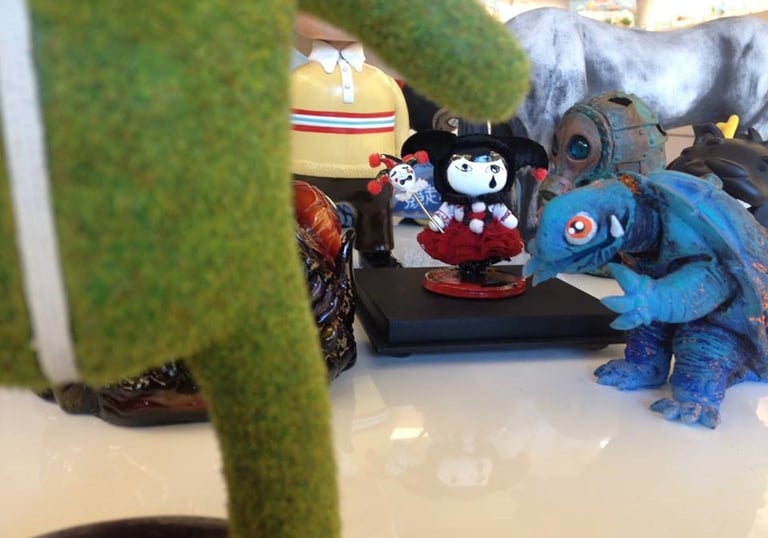
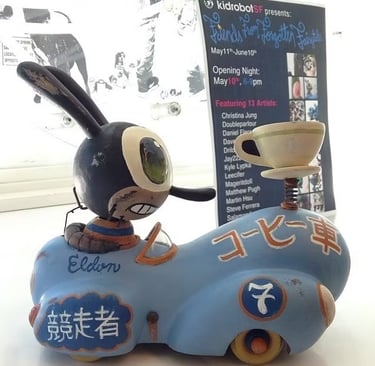
Friends from Forgotten Fairytales was not just a group Show. It was an open wound in disguise. A visual protest wrapped in magic. A Manifesto from characters that never got their happy ending, and didn’t want one.
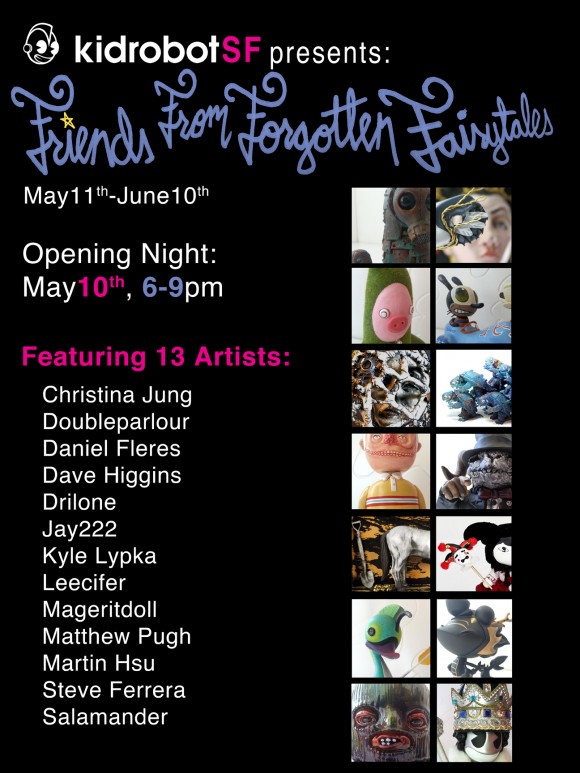
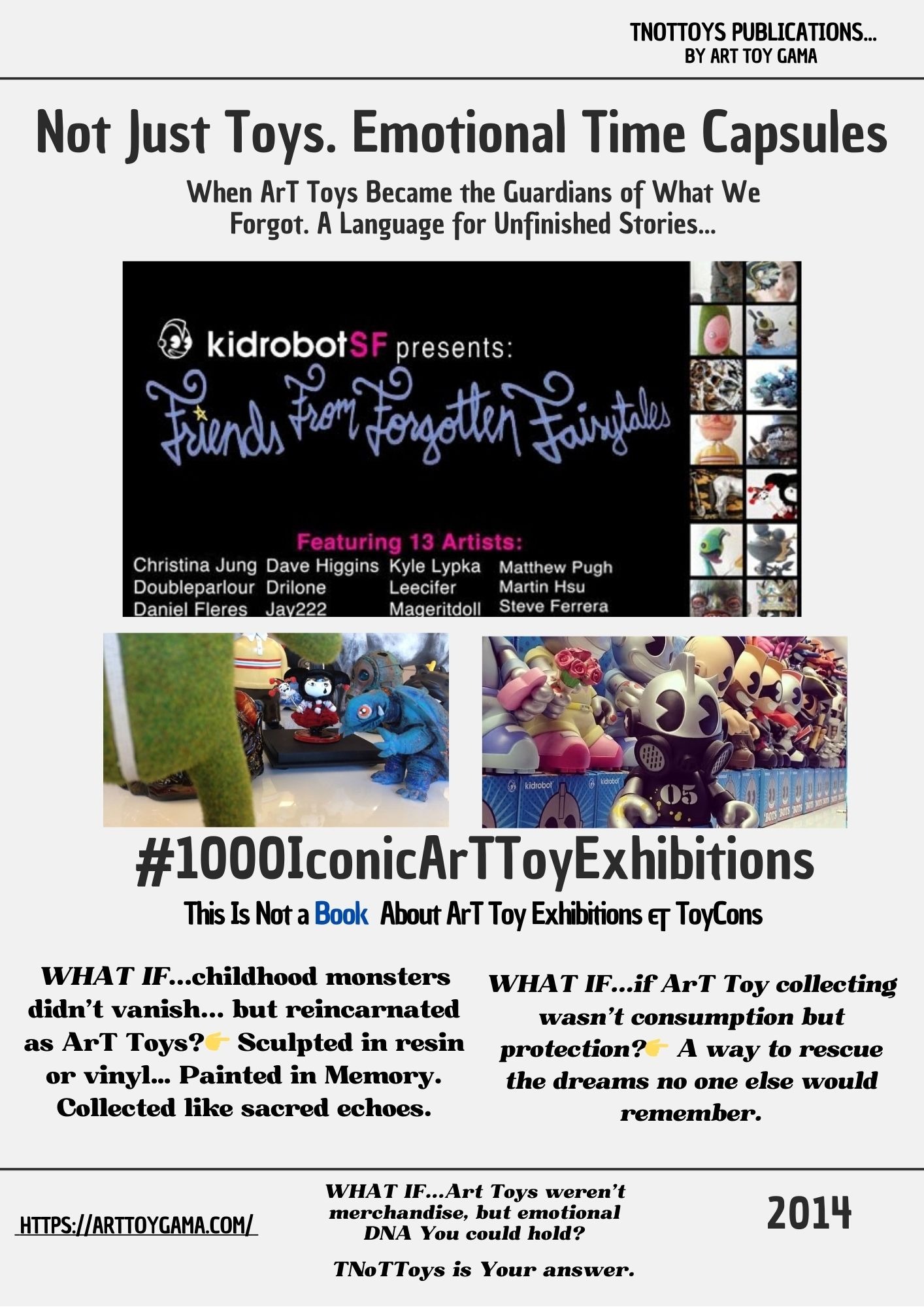
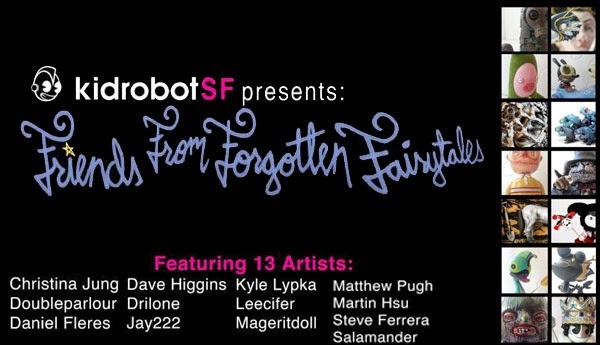
Hosted by Kidrobot SF—once the mecca of Western Designer Toys—the show gathered 13 artists who didn’t play it safe.
Names like Doubleparlour, Drilone, Martin Hsu, Mageritdoll, Salamander, Christina Jung and others, whose styles blurred the lines between grotesque and cute, handmade and haunted, familiar and unplaceable.
It was a truly international lineup—with artists from the U.S. and Europe—bridging aesthetics from lowbrow surrealism to melancholic pop nostalgia. The ArT Toys presented ranged from original one-offs to limited-edition figures, made in vinyl, resin, and mixed media, showcasing a powerful fusion of craft, storytelling, and emotional contradiction.
This wasn’t an Expo about "what looks good on your shelf."
This was about what lives under it.
The ArT Toys shown weren’t characters.
They were relics.
Totems of mythologies that never made it to print.
Fragments of childhood dreams reassembled with stitches and stardust.
Every piece felt like a sentence pulled from a Book no one remembers reading, but everyone somehow lived through.
From kawaii noir to emotional surrealism, from dark fairytale vinyls to resin sculptures with psychological depth, these weren’t just objects.
They were emotional micro-universes.
They didn’t ask to be understood.
They asked to be felt.
🔍 Why It Mattered
In a world still figuring out what ArT Toys could be, Friends from Forgotten Fairytales drew a line in the sand:
ArT Toys are not Trends.
They’re cultural punctuation marks.
And this Show became a turning point:
where the West began embracing a new visual language of personal mythology,
discomfort, and Memory.
It was also the first international exhibition for one of ArT Toy Gama’s co-founders, Cristina A. del Chicca, then showing as Art Toy Maison, with her Mageritdoll resin figure.
And yes…this connection was born through social media.
Before it was called a Movement, Art Toy Gama was already a constellation:
scattered voices, quietly aligning into one rebellion.
And as an extra highlight for collectors and historians alike,
the Exhibition also featured the entire Kidrobot mascot collection by Salamander:
a tribute to the very icon that helped shape the visual identity of the Western Art Toy Movement.
🧬 Legacy & Mutation
Kidrobot—founded in 2002 by Paul Budnitz, inspired by a trip through Asia, wasn’t just a brand.
It was a cultural transmission center.
Its SF store at 1512 Haight Street was more than a gallery.
It was a portal. A place where Toys were never Toys. They were messengers.
And when the original Kidrobot store closed, something else was born in its place:
Woot Bear. A hybrid gallery-retail space that became the rebellious heir of that legacy.
Not just selling collectibles: curating culture.
Because this is what happens when a movement refuses to die.
It mutates.
It reinvents.
Woot Bear is the rebellious child that survived the ghost of Kidrobot.
A space that doesn’t just collect ArT Toys: it celebrates them.
A new chapter in the living, breathing story of the ArT Toy Movement.
The legacy of Friends from Forgotten Fairytales is not only built by the objects shown, but by the ecosystem it activated.
It marked a shift:
From designer toy as “collectible item”
to ArT Toy as memory architecture: emotional, narrative, and communal.
The Show became proof that the Movement wasn’t driven by product cycles, but by mythologies.
By artists who kept inventing new ways to heal their inner children.
By collectors who curated Identity instead of shelves.
By shops that behaved like cultural laboratories more than retail spaces.
The mutation was subtle but irreversible:
Fairytales were no longer decorative.
They became subversive again.
They became tools for confronting nostalgia, grief, and joy: not escaping them.
This Exhibition didn’t only resurrect forgotten fairytales.
It resurrected something inside the collectors too:
the permission to feel weird, fragile, magical, monstrous…
and still call it Art.
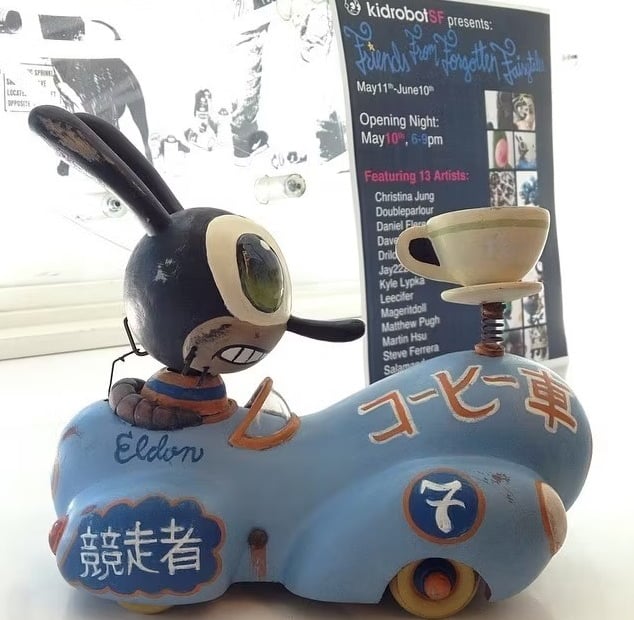
✧ POSTER Reading
The POSTER doesn’t announce a Show.
It opens a wound.
Black background: the void where forgotten stories fall.
On top of it, Kidrobot SF drops neon magenta and electric blue,
a collision between corporate identity and handmade fairytale scribble.
The title twists like a spell that never learned to behave.
DIY energy.
Childlike, but never innocent.
Closer to a whispered memory than to graphic design.
Down the right side: thirteen boxes, thirteen faces, thirteen worlds.
Not thumbnails.
Portals.
Each creature stares back as if awakened mid-sleep,
asking silently:
“Why did you forget us?”
The layout mimics trading cards, zines, sticker sheets…
the unofficial visual language of ArT Toy collectors before the internet learned their names.
It looks underground because it is.
It feels emotional because it must.
This POSTER doesn’t follow gallery grammar.
It follows instinct.
It follows the pulse of a subculture that built itself without permission.
What Story does it tell?
A simple one:
Fairytales don’t die.
They wait.
And they come back sharper.
✧ Energy Behind The POSTER
The POSTER vibrates with contradiction.
Sweet and feral.
Playful and bruised.
Commercial surface, rebellious core.
It carries the energy of a community flyer taped to a lamppost at midnight.
Not polished.
Not approved.
Alive.
This is the emotional temperature of early ArT Toy culture:
chaotic hope, handmade myth, collective mischief.
Every creature in the grid feels like an orphaned Memory.
Every color shouts against the dark.
Every typographic swirl whispers something half-remembered.
Identity:
The POSTER refuses a single aesthetic.
Like the artists it features, it embraces multiplicity.
Memory:
The handwritten title feels like a lost fragment of a childhood dream,
retrieved years later, trembling but intact.
Legacy:
The POSTER becomes an artifact,
not of the Show alone…
but of the era when the Movement still didn’t know it was a Movement.
Rebellion:
No hierarchy.
No hero image.
No institutional calm.
Just creatures, names, time, place: raw and unfiltered.
It behaves like an object, not a support.
A relic.
A memory trigger.
An emotional device.
And it tells us something essential about ArT Toys:
That sometimes the real revolution isn’t sculpted.
Sometimes it’s printed.
Sometimes it’s the POSTER that calls you long before you know why.
🎯 Final Thought from Art Toy Gama
At Art Toy Gama, we say it often:
“Collecting isn’t about owning things.
It’s about showing the world who You refuse to forget.”
Friends from Forgotten Fairytales reminded us why we collect, why we sculpt, and why we never stopped believing in the monsters that once protected us.
Because this wasn’t just a group show…
it was one of the first collective exhibitions in the U.S. to consolidate a very specific aesthetic:
the mutated fairytale, the corrupted childhood, the ArT Toy that refuses to be forgotten.
Each piece wasn’t just an object, it was a mirror of the unspoken,
a visual echo of what we feel but can’t always explain.
These weren’t just toys.
They were Stories that survived extinction.
Because in the end, that’s the secret these forgotten fairytales were trying to tell us:
that Dis(Play) is not decoration, but declaration.
That collecting is not consumption, but remembrance.
And that every ArT Toy, bruised, whimsical, imperfect, is a way of saying:
I was here. I felt this. I refuse to forget who I am.
🧠Still collecting what’s popular? Or are You ready to collect what matters?
👉 Step into the Movement that makes memory visible.
🎯 Explore the Art Toy Gama Store — where forgotten fairytales are just the beginning.
Join The First and Only Art Toy Newsletter Society in the World here: https://emails.arttoygama.com/l/email-subscription
#1000IconicArTToyExhibitions
We’re currently building an Upcoming Publication that explores and celebrates
the most iconic and influential Art Toy exhibitions around the world.
Each article in this series helps document, reflect, and invite the community
to take part in constructing this cultural archive — one exhibition at a time.
We’ve seen countless exhibitions since then: small and large, modest and monumental.
And we love them all.
No matter where they take place or the resources behind them,
every ArT Toy show adds something to the Movement.
Some will make history, others will make Memory. All of them matter.
This is not just documentation.
This is Dis(Play) in the making.
And You’re part of it.
Art Toy Gama Legacy
#ArTToyGamaLegacy
Art Toys. Paintings. Fine Art Prints. Not what You expect.
Real collectors don't follow trends—they redefine them
We didn’t lose our inner child. We turned it into Art.
You collecting, or just hoarding what the algorithm spoon-feeds you?
contact
© 2025. All rights reserved.