We didn’t lose our inner child. We turned it into ArT Toys and More...with purpose.
🎪 Ron English’s Sugar Circus x MINDstyle
When Candy Turned into Cultural Ammunition. Ron English’s Sugar Circus x MINDstyle. Art Toys, Paintings (Shenzhen • 2021–22) #00015 — TNoTToys Publications
1000 ICONIC ART TOY EXHIBITIONSTNOTTOYS PUBLICATIONSTNOTTOYS
Sergio Pampliega Campo & Cristina A. del Chicca
🌀 This post is part of an ongoing research series from Art Toy Gama’s editorial division:
📚 This Is Not a Book About Art Toy Exhibitions & ToyCons
Our Upcoming Art Toy Book: 1000 Iconic ArTToy Exhibitions
Context: Shenzhen, 2021
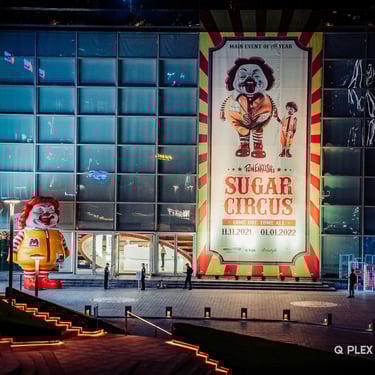
On November 11th, 2021, Shenzhen was no longer just a tech capital in China. For seven weeks, it became the stage of one of Ron English’s most ambitious shows: Sugar Circus.
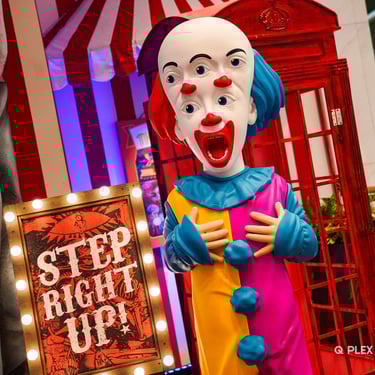
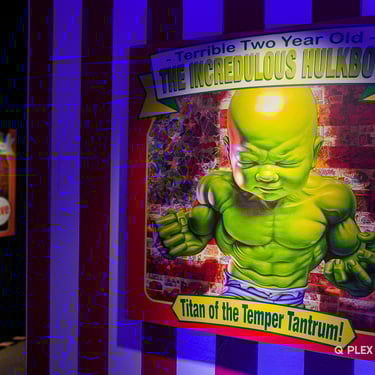
The Nest at Q Plex hosted an immersive installation spanning nearly 10,000 square feet. Paintings, oversized sculptures, ArT Toys, and interactive spaces transformed the venue into a carnival of satire and spectacle. It wasn’t an Exhibition. It was an atmosphere.
This was not a local event. Sugar Circus was conceived as a touring international exhibition in partnership with MINDstyle. After Shenzhen it traveled to Shanghai, Chengdu, Manila, Los Angeles, New York, and Miami. A global circus. A pop spectacle designed to seduce and unsettle in equal measure.
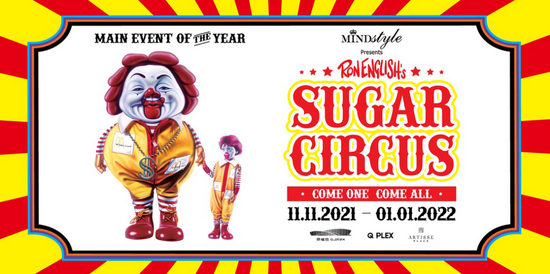
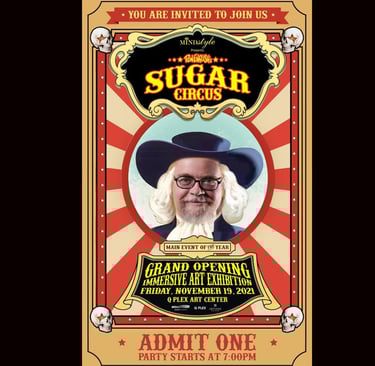
POSTER Reading: A Warning Disguised as Celebration
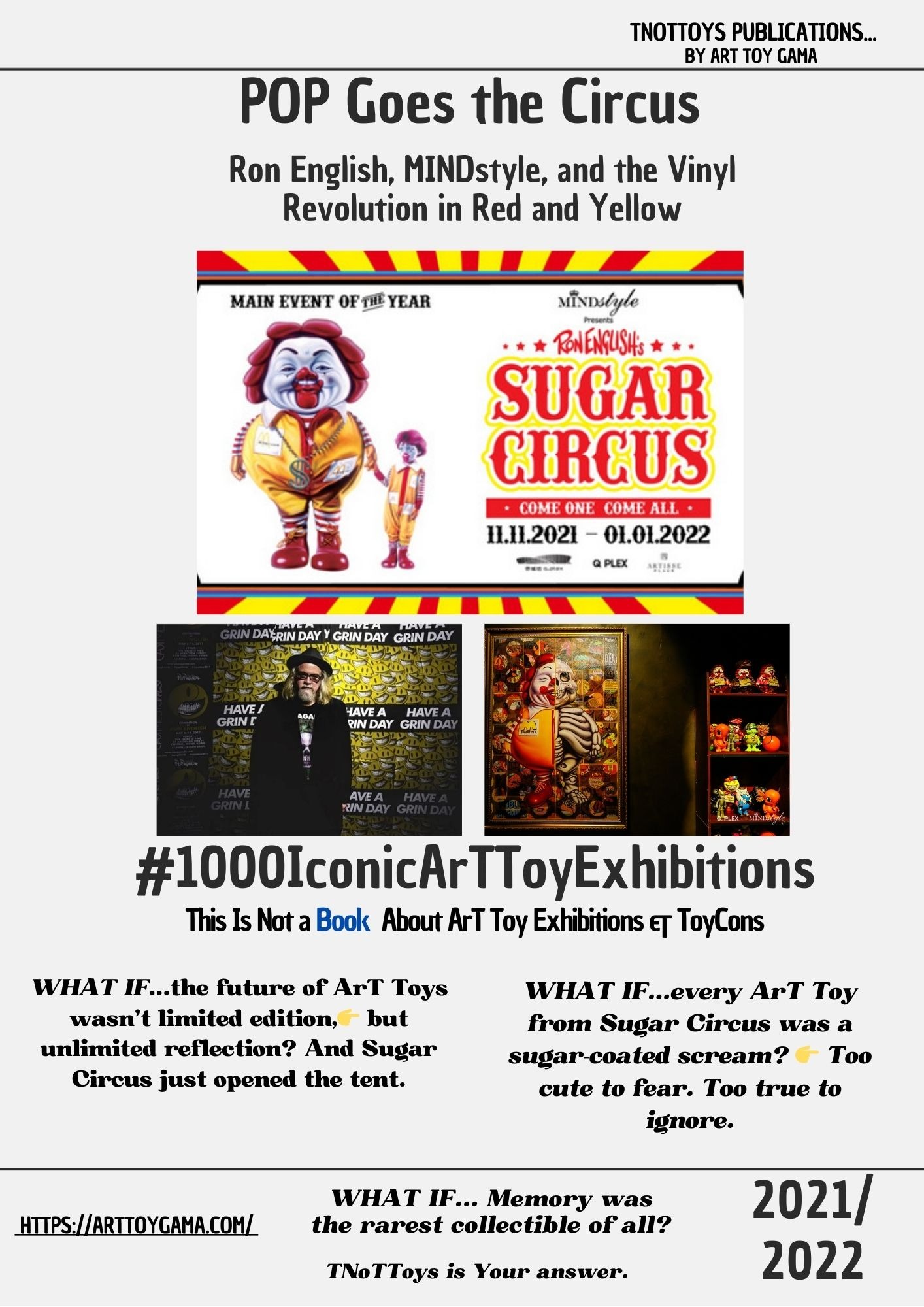
The official POSTER looked like carnival advertising.
Bright yellow and red stripes.
A fat clown in a corporate vest, tongue out, dollar sign on his chest.
It was playful on the surface.
But grotesque once you stared longer.
The obese clown critiqued fast-food culture and childhood obesity.
The melted smile was a reminder that fun and toxicity can look the same.
The small clown-child standing next to him showed the generational transfer of consumerist habits.
The typography screamed circus nostalgia — “MAIN EVENT OF THE YEAR” and “COME ONE COME ALL.” But in this context, those phrases exposed consumption itself as the main event of our time.
The POSTER was not an invitation.
It was a satire of the marketing machine.
A warning disguised as candy.
Poster Reading: The Circus POSTER That Smiles While It Bites
At first glance, the Sugar Circus POSTER looks harmless, even nostalgic.
A cheerful burst of carnival stripes.
A giant clown waving at You with cartoon charm.
Everything smiles.
But Ron English’s POSTERS never smile without consequence.
Look again.
The clown’s tongue is out; swollen, drooping, obscene.
The vest sits too tight on his inflated belly.
The dollar sign chains gleam like warning signs.
His sidekick (a child clown) mirrors him, already infected by the same disease.
Nothing here is festive.
Everything is diagnosis.
1. Typography as Weaponized Nostalgia
The fonts scream circus tradition: woodblock serifs, banner ribbons, star motifs.
But placed next to English’s grotesque clown, they operate like a trap:
Come One, Come All
→ an invitation
→ a threat
→ a prophecy
Language that once sold innocence now sells confrontation.
2. Color Palette: Candy-Coated Toxicity
Yellows, reds, carnival stripes.
Colors of joy, sugar, safety.
In English’s universe?
They become hazard tape.
The palette tells two stories at once:
• the circus You remember
• the capitalism You try not to see
3. Composition: A Corporate God and His Heir
The giant obese clown occupies the left side like a deity of consumption.
The child stands beside him; smaller, obedient, already marked by the same pathology.
This is inheritance.
This is indoctrination.
This is fast-food mythology illustrated in vinyl flesh.
4. Branding Inside the Satire
MINDstyle’s logo sits at the top.
Clean. Corporate. Bold.
Placed above a rotting clown it becomes ironic commentary:
The brand crowns the critique.
The circus is both spectacle and business.
5. The POSTER as Cultural Object
ThisIs Not promotional material.
This is a political cartoon disguised as family entertainment.
Ron English sells critique in the shape of a carnival.
You laugh… until you realize You’re laughing at Yourself.
✧ Energy Behind The POSTER :
The Emotional Pulse of Sugar Circus
Where most POSTERS attract visitors, this one destabilizes them.
Its emotional engine runs on contradiction.
Identity
The clown is Not a mascot.
He is a mirror.
Every viewer sees a version of themselves shaped by consumption, comfort, excess, branding.
Memory
The POSTER taps into childhood circus nostalgia; then corrupts it.
Memory is flipped upside down.
What was safe is now grotesque.
Rebellion
Sugar Circus is rebellion masked as fun:
• fun-house satire
• candy-coated critique
• clown-as-capitalist-monster
This is political Pop.
Atmosphere
The POSTER radiates carnival heat, but beneath it lies dread.
It’s cheerful the way a warning is bright.
It’s seductive the way sugar is addictive.
Legacy
This POSTER announces that ArT Toys are now cultural ammunition.
Not decoration.
Not merch.
A weapon wrapped in innocence.
✧ Extended POSTER Reading: The Semiotic Circus Frame
If Sugar Circus is a traveling carnival of critique, the POSTER is its first rigged tent: a stage where the semiotics of spectacle are weaponized before visitors even enter the show.
At first glance it behaves like real circus advertising.
But its frame, its hierarchy, and its branded architecture turn the POSTER into a cultural booby trap.
1. The Code of Spectacle: The Frame as Psychological Setup
The red-and-yellow striped border doesn’t decorate the image, it programs it.
It’s the chromatic shorthand of carnivals, fairs, and childhood joy.
A frame engineered to trigger nostalgia
→ so the critique inside can land even harder.
The Semiotic Inversion:
Symbols of innocence become wrappers for toxicity.
English uses circus language the way he uses corporate mascots:
as bait.
The frame says: “This will be fun.”
The clowns inside whisper: “This is what fun has done to You.”
2. The Dynamic of the Two Figures: Generational Transfer
The POSTER doesn’t present a hero image.
It stages a relationship.
The obese clown… corporate patriarch of excess.
The small clown-child… apprentice inheriting the sickness.
Their pairing turns the POSTER into a sociological diagram:
· The adult = final mutation
· The child = cultural indoctrination
· The costume = Identity passed down
· The dollar chain = the new family crest
It’s not character design.
It’s a genealogy of consumption.
3. Shenzhen as Stage: Geography as Message
Placing Sugar Circus in Shenzhen adds a layer the POSTER quietly amplifies.
Shenzhen is:
• a capital of global manufacturing
• an engine of new consumer culture
• a city where Western branding meets Eastern appetite
So the POSTER becomes prophecy:
“This is what happens when consumption spreads unchecked.”
The circus tent printed on the POSTER becomes metaphor for globalized spectacle: a traveling critique visiting every market that feeds the machine.
4. Branding as Architecture: The Corporate Frame of Critique
The POSTER lists four major players around English’s imagery,
not as afterthoughts, but as structural pillars:
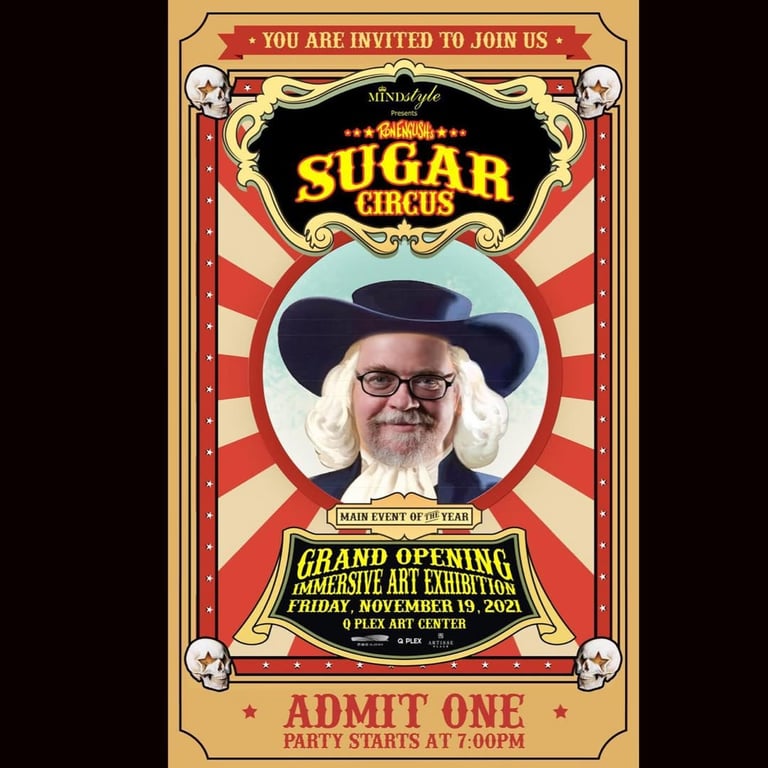
MINDstyle — “Presents”
Not just a sponsor.
The producer of the spectacle.
The engine that scales English’s critique into global tour format.
A perfect Popaganda paradox:
to criticize branding, the Art must become branded.
Q Plex — the architectural host
A massive, tech-forward venue.
The kind of space designed not for white-cube contemplation but for immersive spectacle.
The POSTER uses its logo to declare:
“This critique requires infrastructure.”
Artisse Plaza. the commercial ecosystem
Its presence signals that Sugar Circus is not hiding in an Art bunker.
It is installed directly in the flow of public consumption.
The circus critiques capitalism
inside capitalism.
歌兰 (Ge Lan / GLORIAM) — cultural anchoring
A local Chinese lifestyle brand positioned alongside Western partners,
proof that Sugar Circus is not exporting criticism but integrating into a hybrid economy of desire.
The POSTER becomes a world map in miniature:
East + West + Pop + Luxury + Spectacle.
5. The POSTER as Business Card and Bomb
The POSTER functions as two contradictory objects:
A corporate billboard
AND
a detonator of cultural critique.
Its message:
“You cannot separate spectacle from its sponsors.
You cannot separate critique from the machine that funds it.”
Sugar Circus doesn’t attack the circus.
It becomes the circus
to expose its machinery from within.
What the Exhibition Showed
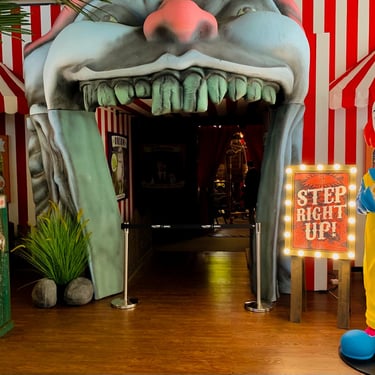
Inside Sugar Circus visitors found a feast for the senses.
Gigantic sculptures of English’s mutant icons stood like monuments. His obese clowns. His twisted mascots. His grinning mutations of childhood culture.
Original paintings exploded with color and irony. Resin ArT Toys blurred the line between collectible and fine Art. Immersive rooms became stages for both critique and selfies: a place where spectacle and reflection collided.
The gift shop itself played a role in the narrative. It wasn’t just a store. It was the public’s chance to take a piece of the spectacle home. To transform satire into collectible. To transform protest into possession.
It was Disneyland meeting dystopia. Pop culture made carnival. Consumption turned into confrontation.
Why It Mattered
Ron English has spent decades twisting pop icons into what he calls POPaganda: elegant Art fused with mass culture. He gave us MC Supersized, the obese Ronald McDonald eating himself alive. He reimagined Charlie Brown as “Grin.” He transformed Marilyn Monroe into a hybrid of consumer icons.
With Sugar Circus he brought that universe into an immersive scale. For the first time in China, his world wasn’t confined to canvas or toy form. It was an entire carnival where capitalism itself became the clown.
This mattered for the Art Toy Movement.
It proved that ArT Toys are not decoration. They are protest objects. They can stand in museums, but also in malls. They can be fine art and still be populist spectacle. They can criticize the system while selling tickets and toys in its face.
Like Kidrobot once democratized ArT Toys, Sugar Circus turned them into something inescapable. A reminder that collecting isn’t about owning. It’s about confronting.
Legacy & Mutation: Ron English, MINDstyle, and the Art Toy Movement
Ron English is called the Godfather of Street Art. His murals appear on walls worldwide. His characters are in books, movies, and television. He reimagines history, from The Last Supper to Guernica, through his own pop surrealist lens.
In partnership with MINDstyle, Sugar Circus became not only an exhibition but a traveling populist spectacle. A high-brow Art experience presented as a circus anyone could enter. It was a mutation of gallery culture. A way to place Toys, paintings, and installations in a space where children and collectors, influencers and critics, all stood on the same ground.
And that’s why it mattered. It redefined what ArT Toys can be. Not small editions hidden in glass cases. But cultural ammunition at architectural scale.
Final Thought from Art Toy Gama
At Art Toy Gama, we don’t see clowns. We see mirrors.
Sugar Circus looked like candy but it tasted like critique. It seduced with absurdity, then haunted with reflection. It reminded us that Play is not childish. Display is not ego. To collect is to resist forgetting. To create is to remember without fear.
Ron English’s obese clown wasn’t just entertainment. It was a global critique standing in a gallery. A collectible turned into protest. A reminder that even the sweetest spectacle hides a toxic truth.
That is why we say: Dis(Play) is the New Memory.
👉 If you’re collecting only what feels safe, You’ve missed the circus.
👉 If you’re ready to collect rebellion wrapped in resin, welcome to Art Toy Gama.
👉 Step into our store. Don’t just collect. Multiply your tribe.
Join The First and Only Art Toy Newsletter Society in the World here: https://emails.arttoygama.com/l/email-subscription
#1000IconicArTToyExhibitions
We’re currently building an Upcoming Publication that explores and celebrates
the most iconic and influential Art Toy exhibitions around the world.
Each article in this series helps document, reflect, and invite the community
to take part in constructing this cultural archive — one exhibition at a time.
We’ve seen countless exhibitions since then: small and large, modest and monumental.
And we love them all.
No matter where they take place or the resources behind them,
every ArT Toy show adds something to the Movement.
Some will make history, others will make Memory. All of them matter.
This is not just documentation.
This is Dis(Play) in the making.
And You’re part of it.
Art Toy Gama Legacy
#ArTToyGamaLegacy
Art Toys. Paintings. Fine Art Prints. Not what You expect.
Real collectors don't follow trends—they redefine them
We didn’t lose our inner child. We turned it into Art.
You collecting, or just hoarding what the algorithm spoon-feeds you?
contact
© 2025. All rights reserved.