We didn’t lose our inner child. We turned it into ArT Toys and More...with purpose.
Beyond Ultraman: The Poster that Pushed ArT Toys Forward
In 2007, PMCA’s Beyond Ultraman made designer vinyl museum serious. It was a 7 artists Vinyl Rebellion that changed Art History#00024—TNoTToys Publications
1000 ICONIC ART TOY EXHIBITIONSTNOTTOYS PUBLICATIONSTNOTTOYS
Sergio Pampliega Campo & Cristina A. del Chicca
🌀 This post is part of an ongoing research series from Art Toy Gama’s editorial division:
📚 This Is Not a Book About Art Toy Exhibitions & ToyCons
Context Matters
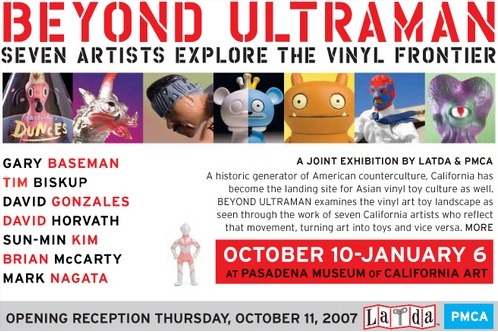
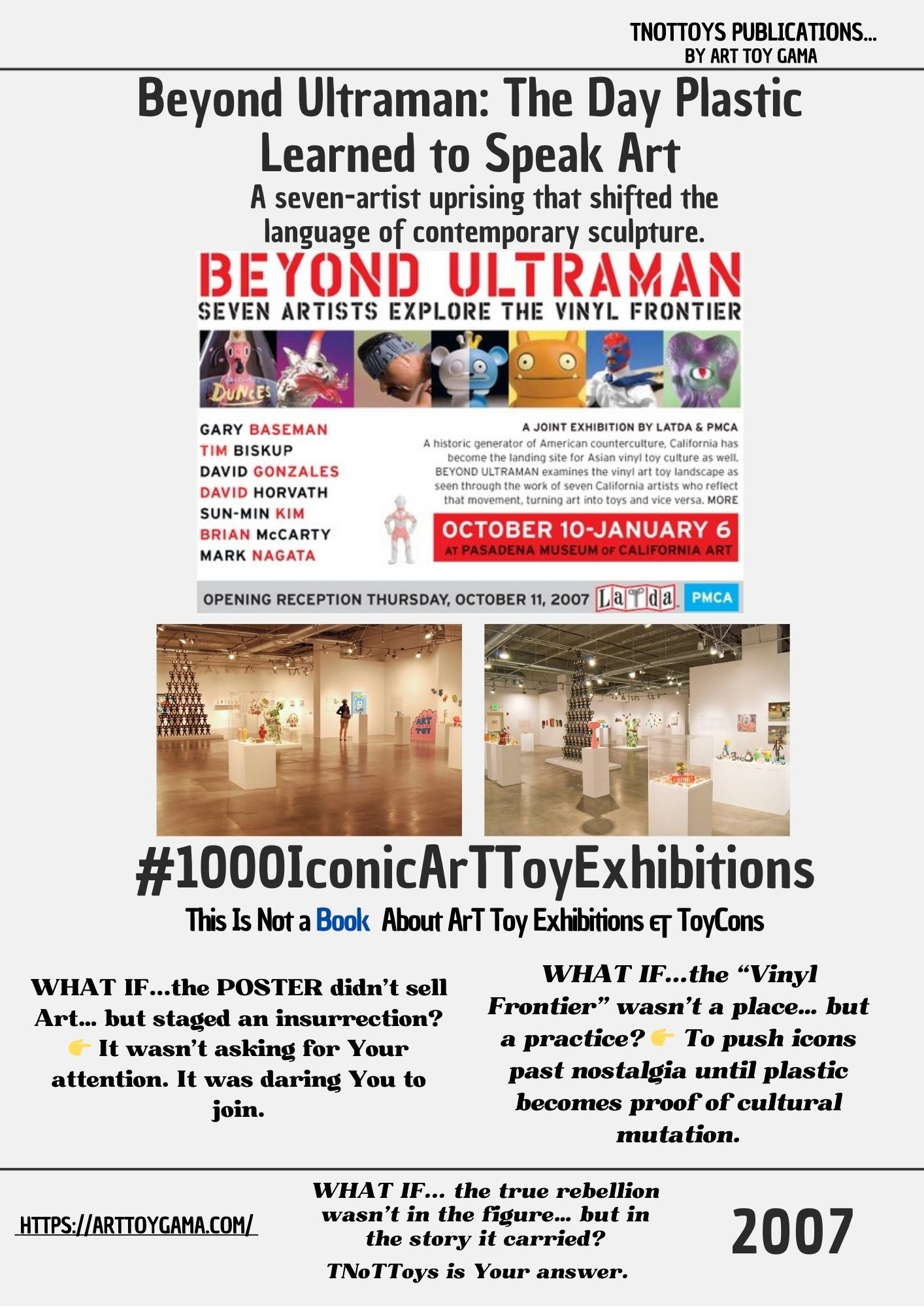
You’re in Pasadena, fall 2007. Not a convention hall, a museum. The Pasadena Museum of California Art joins forces with LATDA (the Los Angeles Toy, Doll & Amusements Museum) and opens Beyond Ultraman: Seven Artists Explore the Vinyl Frontier from October 10 to January 6.
For the first time in the U.S.,
an institution frames designer vinyl as contemporary Art rather than niche fandom.
This was a critical year for American Lowbrow Art.
Pop Surrealism and Lowbrow Art were already highly influential.
It was a moment of cultural crossing.
The ArT Toy Movement desperately sought mainstream acceptance…
…and California is the perfect launchpad:
West Coast counterculture meets Asian sofubi heritage.
The Show doubles as history lesson and field guide:
timeline, process from sketch to mold to figure,
plus a Catalog with essays by Ivan Vartanian and Maria Kwong.
It’s museums saying:
this isn’t cute; this is culture. It positioned vinyl not as a Toy, but as Art History.
POSTER Reading
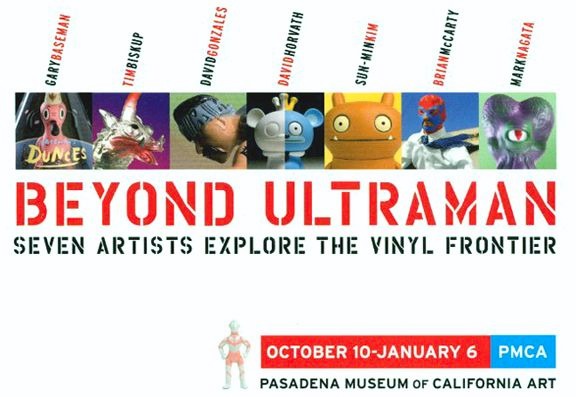
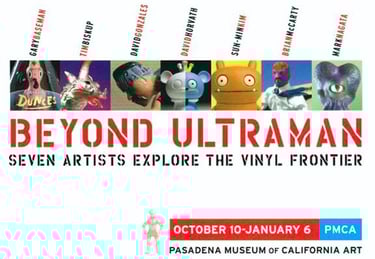
The Exhibition POSTER functions as a visual Manifesto.
It is not just a piece of marketing. The design is bold, functional, and urgent.
It uses a strong, simplified color palette.
The POSTER doesn’t whisper; it commands. “BEYOND ULTRAMAN” in red stencil reads like an evacuation order—industrial, urgent. This font choice is intentional. It combines sci-fi brutalism with street-level urgency. It declares a dramatic narrative challenge. Beneath it, seven characters stand shoulder to shoulder, each a visual totem.
The subtitle, “SEVEN ARTISTS EXPLORE THE VINYL FRONTIER”, feels like a mission briefing, not marketing copy. You’re not invited to browse; You’re recruited.
Color blocks are flat and unapologetic; typography is cold-hot, mechanical yet emotional. The lineup promises a clash of myth and manufacturing, childhood and critique. It signals that the “frontier” isn’t outer space; it’s the blurred edge where merchandise mutates into mythology.
Each artist’s character stands like a sentry
clean backgrounds
bold colors
fixed gazes
one lineup
seven totems
seven emotional languages
the vinyl army assembled.
✧ The POSTER’s Hidden Architecture
The Blueprint Behind the Vinyl Frontier
At first glance, the Beyond Ultraman POSTER feels simple.
Bold title. Seven figures. A block of red urgency.
But beneath that simplicity lies a carefully engineered declaration,
a visual blueprint for how vinyl enters the museum.
This is the architecture the POSTER hides in plain sight.
1. Typography as Shock Signal
The red stencil type isn’t decorative.
It is industrial.
Evacuative.
A font used for crates, warnings, and military logistics; not gallery calm.
It tells You immediately:
This Is Not an Exhibition,
it is an operation.
The sharp edges and mechanical rhythm signal a collision:
sci-fi futurism × factory realism.
A nod to Ultraman’s tokusatsu lineage and to the production lines where vinyl is born.
Typography becomes narrative:
we are entering a frontier built from both mythology and manufacturing.
2. Color as Narrative Atmosphere
Red. White. Black.
A palette of danger, purity, and authority.
Red → urgency, mutation, cultural heat.
White → the museum frame, the institutional space.
Black → the void of possibility, the unknown frontier.
Together they create an emotional triad:
alertness, clarity, tension.
The same emotional palette that defined the early vinyl era,
half fandom pulse, half cultural rupture.
3. Composition: The Lineup as Mythology
The seven figures aren’t placed casually.
They stand in formation.
Aligned, equidistant, evenly lit.
This Is Not a collage of characters.
It is a seven-point manifesto.
Each figure acts as an emblem:
Baseman’s tenderness,
Biskup’s geometry,
Horvath & Sun-Min’s empathy,
Gonzales’ barrio pulse,
McCarty’s photography-as-fiction,
Nagata’s kaiju resurrection.
Seven viewpoints, one frontier.
The lineup reads as ritual:
a council of vinyl elders preparing to cross into Art history.
4. The POSTER as Cultural Object (Not Advertisement)
Museum posters usually highlight one artwork,
one hero image,
one anchor.
Not here.
This POSTER refuses “hero logic.”
It presents vinyl as multiplicity,
as polyphony,
as collective authorship.
It behaves less like announcement,
and more like a treaty:
vinyl will enter the Museum as a group, or not at all.
This is the opposite of pop-culture marketing.
It’s closer to a political POSTER ,
a march announcement,
a declaration of presence.
The message is clear:
vinyl is not waiting to be invited into the institution,
it is arriving as a coalition.
5. The Frontier Framed as Cultural Territory
“The Vinyl Frontier” isn’t metaphor.
It is cartography.
By showing seven figures in formation,
the POSTER maps out a new artistic territory:
a space between sculpture and merchandise,
between nostalgia and critique,
between childhood myth and adult commentary.
This is the first Museum POSTER to frame vinyl as:
· a medium of rebellion
· a platform for identity
· a site of cultural rewriting
The POSTER stops being layout.
It becomes border crossing.
6. What the POSTER Says Without Saying
It says the Movement is ready.
It says vinyl is mature enough for scholarship.
It says the figure is no longer a commodity,
but a cultural witness.
It doesn’t whisper.
It doesn’t seduce.
It declares:
This is Art.
This is History.
This is the frontier you were not expecting.
Energy Behind the POSTER
The energy of the Show was one of tactical insurgency. It was a planned revolt against established media. The mood was serious, not playful.
The Exhibition challenged intellectual property directly. It took the Memory of Ultraman, a global icon, as its starting point. It then demanded viewers look past the icon’s surface. This generates critical cognitive dissonance.
The Show focused on the “entrails of creation.” It explored the inspiration and manifestation of the art toy landscape. This provided a necessary artistic overview. It captured the attention of both audiences equally.
The overall pulse was symbolic and narrative. It presented the ArT Toy not as a commodity; it framed the vinyl piece as an emotional machine. It was a powerful symbol of postmodern identity.
The Vinyl as History: The choice of vinyl is crucial. It’s the material memory of post-war consumerism and pop culture. By exploring this “frontier,” the artists engage in material archaeology, using the plasticity of vinyl to reflect the plasticity of cultural myth itself.
What the Exhibition Showed
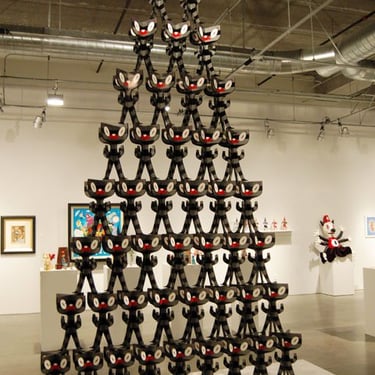
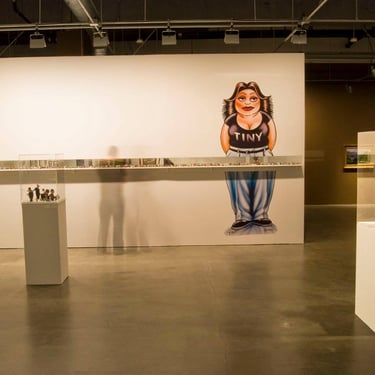
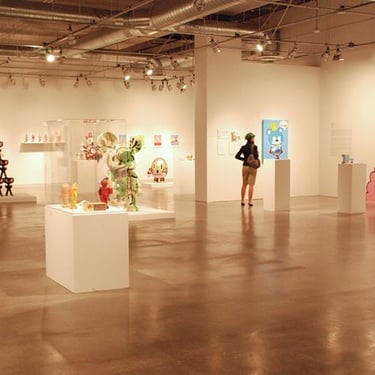
The gallery space was converted into a hybrid zone: a crash site where Asian Kaiju heritage met American individualism. The Exhibition showed the “entrails of creation.”
The Show primarily featured the specific work of the seven California artists. It showcased how each forwarded the Vinyl Toy Movement. The Catalog detailed the inspirations behind their creations.
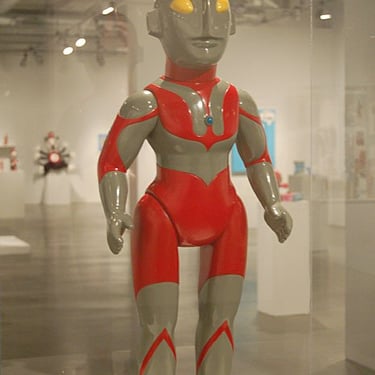
Artists explored the vinyl medium through unique lenses. Gary Baseman brought his character-based emotional narratives. Tim Biskup provided abstract, psychedelic formal explorations. David Horvath and Sun-Min Kim introduced emotional resonance through characters like the Uglydolls. Brian McCarty’s work transformed ArT Toys into emotional actors through photography. David Gonzales honored his barrio: Homies standing with pride and irony, street meets vinyl. And Nagata brought Ultraman home; a Sansei warrior reinterpreting Japan through California eyes. His sofubi wasn’t tribute… it was resurrection.
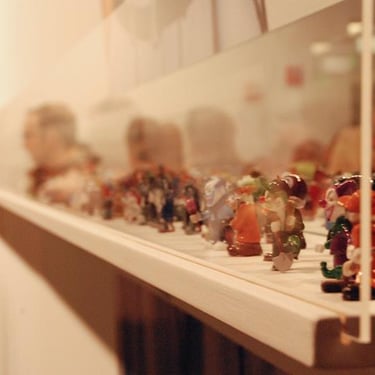
The Exhibition showed diverse forms of Art: paintings, sculptures, and photography. It showed sketches, prototypes, and the actual figures, revealing the full scope of the creative process.
The pieces demonstrated the vinyl toy’s versatility. They proved the figure could serve as a canvas for complex ideas. The Show established that these objects were cultural agents, not novelties.
Why It Mattered
This was a seminal event, the first museum show exclusively devoted to Designer Vinyl in the U.S. This simple fact caused a major rupture. It instantly validated the entire movement.
The Exhibition successfully bridged two worlds. It brought serious Art collectors into the Toy community, and simultaneously brought Toy collectors into the museum space. This was a vital achievement.
It cemented the ArT Toy’s place in contemporary Art discourse. The Show moved the Movement beyond niche galleries and elevated the vinyl platform to the mainstream. This shifted the identity of the entire scene.
The Catalog itself became an important document. It served as a historical overview of the early 2000s ArT Toy landscape. It provided essential scholarly context for the genre.
In short, the Show splits the timeline. Before 2007, vinyl was mostly “underground.” After 2007, it’s institutional. Museums legitimize a medium that hijacks mass-market IP for high-concept commentary: the same way Pop Art once reframed soup cans, and sneakers reframed performance into culture.
It also broadens ownership. As curator Maria Kwong notes, artists now self-produce and reach beyond white-wall spaces; museums respond by exhibiting what speaks to both critics and civilians. That accessibility is not dilution; it’s strategy.
About the Artists / Gallery / Scene
The Exhibition was a flagship project resulting from the partnership between PMCA and LATDA.
Maria Kwong curated the show, providing the critical lens the Movement needed.
The seven featured artists were all based in California. This geographic focus highlighted the state’s central role. California was confirmed as the epicenter of Pop Surrealism.
The artists were already established influencers. Each had distinct links to forwarding the Vinyl Movement. They brought diverse visual languages to the shared theme.
The Show celebrated artists who had already broken through boundaries. Their work had claimed space outside traditional toy culture. Their inclusion solidified their legacy…
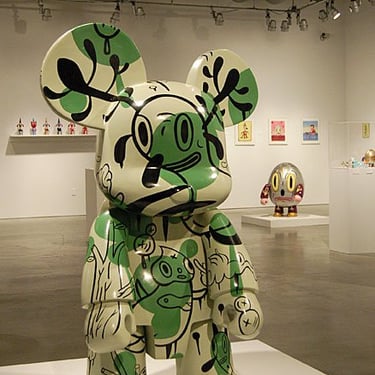
Gary Baseman weaves recurring characters (like Toby) through painting, drawing, and object: a biography in vinyl. His ArT Toys read like tender exorcisms; not merch from paintings, but paintings that leak into Toys.
Tim Biskup brings graphic psychedelia… geometry in motion, rhythm over narrative: figures that feel like abstract jazz pressed into plastic.
David Gonzales channels Chicano identity through Homies: social portraits that laugh, respect, and critique at once.
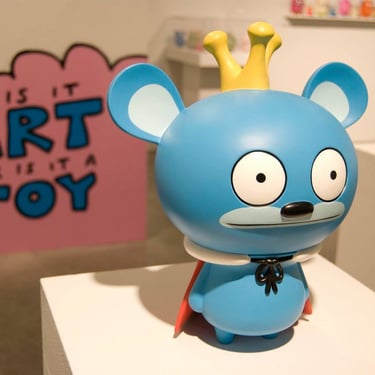
David Horvath & Sun-Min Kim give You empathy made weird: Uglydolls and related creatures, soft and asymmetric, turning awkwardness into a universal language.
Brian McCarty doesn’t sculpt; he directs…photographing ArT Toys on location like actors with inner lives.
Mark Nagata, Sansei kaiju revivalist, bridges tokusatsu legacy and California reinvention: his Eyezon roaring with heritage and new intent.
Legacy & Mutation
Beyond Ultraman was not just timely; it was prophetic. It marked a critical shift, from underground circulation to institutional legitimation.
The Movement, which had grown from Japanese sofubi traditions, lowbrow aesthetics, and street culture, now had a museum-sanctioned voice.
The Exhibition’s legacy is the institutional acceptance of vinyl. It provided the model for all subsequent museum Art Toy shows. It established the material’s archival value.
It embodies the concept Dis(Play) is the New Memory. The original Ultraman is the cultural Memory. The act of displaying the artists’ mutated figures created the New Memory.
The vinyl piece becomes a living document. ArT Toys became Memory-objects. Memory became aesthetic action. The collector was no longer passive. The artist no longer “just made Toys.” The gallery was no longer neutral.
This was an Act of vinyl activism. And it changed everything.
The Show proved the ArT Toy is an ideal medium: perfect for both emotional and commercial narratives. It demonstrated the object’s ability to resist simple categorization. Vinyl stops being passive; it remembers and resists. The ArT Toy becomes an artifact of activism, and consolidated as hybrid artistic media charged with political critique and symbolic rebellion.
The Vinyl Frontier remains the Movement’s defining intellectual space. This Show codified that frontier. It confirmed the ArT Toy as a vehicle for permanent rebellion.
The ripple is measurable: future museum shows, new scholarship, and a collector mindset that treats shelves as living archives. From Pasadena outward, the Movement learns to speak fluent museum without losing street grammar.
Final Thought / Curatorial Reflection
Beyond Ultraman was a masterful Act of cultural insurgency. It didn’t just showcase ArT Toys. It staged an intervention into what Art should be. The artists proved the power of the tangible artifact.
The Exhibition was about material history. It showed that the consumer object is capable of critical depth. The PMCA opened the door to a new definition of sculpture.
The ArT Toy is the new history book. The vinyl is the new paper. Collecting these pieces means archiving a revolution.
We don’t just own these figures; we own the moment they changed Art forever.
That is the permanent triumph of the Vinyl Frontier.
In another sense, that POSTER wasn’t selling a sample. It was recruiting an avant-garde. Seven figures in formation: less advertising, more oath.
From then on, vinyl stopped asking for permission and started dictating the rules.
In other words: the Vinyl Frontier isn’t a place. It’s a practice.
Push icons past nostalgia and You don’t just collect myth…You collect evidence of its beautiful deformation.
Ready to claim your piece?
Join The First and Only Art Toy Newsletter Society in the World here: https://emails.arttoygama.com/l/email-subscription
🔗 ENTER THE ART TOY GAMA STORE
#1000IconicArTToyExhibitions
We’re currently building an Upcoming Publication that explores and celebrates
the most iconic and influential Art Toy exhibitions around the world.
Each article in this series helps document, reflect, and invite the community
to take part in constructing this cultural archive — one exhibition at a time.
We’ve seen countless exhibitions since then: small and large, modest and monumental.
And we love them all.
No matter where they take place or the resources behind them,
every ArT Toy show adds something to the Movement.
Some will make history, others will make Memory. All of them matter.
This is not just documentation.
This is Dis(Play) in the making.
And You’re part of it.
Art Toy Gama Legacy
#ArTToyGamaLegacy
Art Toys. Paintings. Fine Art Prints. Not what You expect.
Real collectors don't follow trends—they redefine them

We didn’t lose our inner child. We turned it into Art.
You collecting, or just hoarding what the algorithm spoon-feeds you?
contact
© 2025. All rights reserved.