We didn’t lose our inner child. We turned it into ArT Toys and More...with purpose.
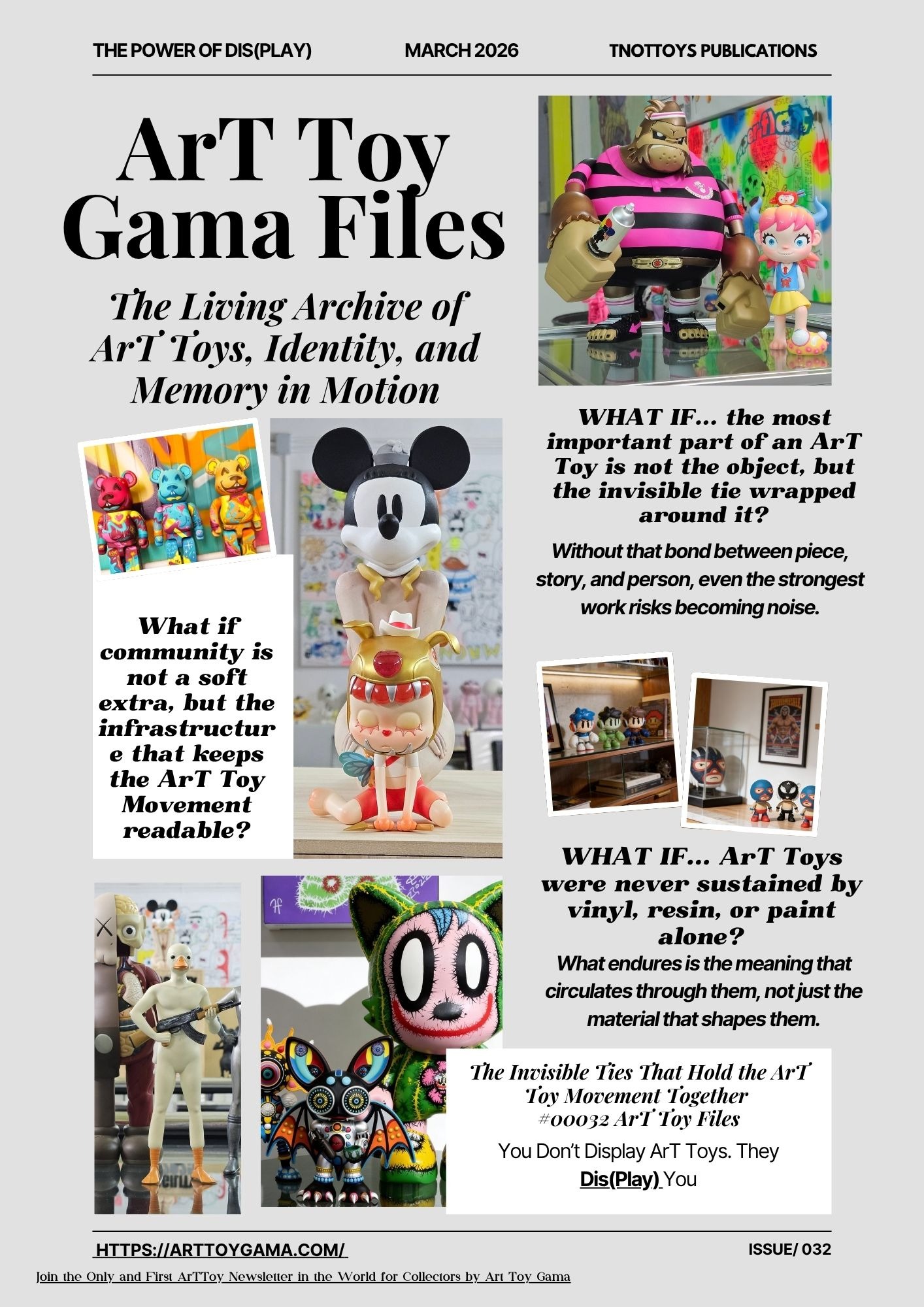
The Invisible Ties That Hold the ArT Toy Movement Together
The Invisible Ties That Hold the ArT Toy Movement: A deeper reflection on ArT, collectors, artists, curators, galleries and shops. #00032 ArT Toy FILES
ART TOY FILES
Sergio Pampliega Campo & Cristina A. del Chicca
3/31/20267 min read
Uncovering the Stories, Creators and Culture Behind #ArTToys
An Art Toy Gama Perspective
The ArT Toy Movement will not collapse because there are too few launches.
It will not weaken because there are too few exhibitions.
It will not disappear because there are too few sales.
If danger comes, it will arrive dressed as success.
As Movement.
As noise.
As constant activity.
As a calendar full of drops, fairs, collaborations, openings, posts,
reels, unboxings, previews, and sold-out announcements.
That is the uncomfortable part.
Because from the outside, a culture can look alive long
after something essential has already started to fail.
And what fails first is rarely the object.
It is the invisible tie around the object.
The fragile but necessary bond between artist and collector.
Between collector and meaning.
Between gallery and courage.
Between curator and context.
Between shop and story.
Between brand and cultural responsibility.
Between exhibition and memory.
Between the piece and the reason it deserves to exist in the first place.
That is where the real pressure builds.
Not on the shelf.
Under it.
A Movement Is Not Sustained by ArT Toys Alone
This may sound strange coming from people who love ArT Toys
as much as we do, but it needs to be said clearly:
ArT Toys alone do not sustain the ArT Toy Movement.
Objects matter.
Of course they do.
They are the visible part.
The emotional trigger.
The material proof that a world, a voice, a rebellion took form.
But a Movement is never held together by material alone.
Nike was never just rubber and fabric.
Apple was never just metal and circuits.
Supreme was never just cotton.
And ArT Toys were never just vinyl, resin, paint, or packaging.
What gives any cultural form endurance is the meaning circulating through it.
Its language.
Its rituals.
Its memory.
Its capacity to connect people through something deeper than transaction.
The moment a culture forgets that, it starts producing presence without depth.
And that is when exhaustion begins.
The ArT Toy Collector Does Not Burn Out Because of Collecting
The collector burns out when collecting stops meaning anything.
That is the part too many people still refuse to confront.
An ArT Toy Collector can live with scarcity.
With delay.
With frustration.
With prices.
With the pain of missing a piece.
What truly erodes the collector is something quieter:
the feeling that everything starts looking interchangeable.
Another launch.
Another teaser.
Another collaboration with no real tension behind it.
Another exhibition that displays objects but says nothing.
Another feed full of images but empty of language.
Another cycle of hype with no memory attached.
At first, the collector keeps going.
Then the connection weakens.
Then the shelf stops speaking.
And once the collector no longer feels Identity, Memory, Rebellion, or Legacy moving through the pieces, the habit becomes lighter, flatter, more mechanical.
That is when collecting risks becoming consumption.
And consumption is always more fragile than devotion.
When Isolation Starts Dressing Like Vision
There is another risk we do not talk about enough.
When the invisible ties around a Movement begin to weaken, people do not only lose context.
They begin to lose orientation.
And that changes the way they read their own desire.
A collector may think the answer is a bigger piece.
An artist may think the answer is reinvention.
A curator may think the answer is a more dramatic gesture.
A gallery may think the answer is scale.
A shop may think the answer is more velocity.
A brand may think the answer is louder visibility.
But sometimes none of those are the real answer.
Sometimes what is missing is not expansion.
It is recognition.
It is dialogue.
It is the presence of other people who understand why this piece, this image, this exhibition, this object, this language matters in the first place.
That matters because ArT Toys have never been sustained by acquisition alone.
They are sustained by interpretation.
By shared reading.
By the feeling that what moves you is not random, private, or disposable, but part of a living culture that can answer back.
Without that, isolation becomes dangerous.
It starts translating emotional hunger into cultural decisions.
“I need better conversation”
turns into
“I need a bigger move.”
“I need sharper context”
turns into
“I need to change everything.”
“I need real community”
turns into
“I need more.”
And “more” is not always meaning.
Sometimes it is just loneliness wearing the costume of ambition.
That is why community is not a soft extra around the ArT Toy Movement.
It is not branding language.
It is not decoration.
It is interpretive infrastructure.
It helps collectors understand what they love.
It helps artists understand what they are building.
It helps curators, galleries, shops, and brands understand that what they are shaping is not only attention, but memory.
Because when people are left alone with the algorithm, with the market, and with their own impulses, even good instincts can become distorted.
And a Movement begins weakening not only when its ties disappear between people,
but when the people inside it can no longer read themselves clearly.
When Social Networks Stop Being Social
There is another problem here.
One that grows quietly in the background while everyone keeps posting.
Social networks are becoming less social by the day.
Less conversation.
Less community.
Less shared discovery.
More prediction.
More segmentation.
More repetition.
Less network.
More Interest Media.
You are no longer simply meeting people.
You are being sorted by appetite.
Fed more of what keeps attention moving.
More of what resembles what already worked.
More of what can be consumed fast, liked fast, forgotten fast.
And that logic is poison for any Movement that depends on cultural depth.
Because the ArT Toy Movement was never meant to be built on passive interest alone.
It was built on encounter.
On friction.
On surprise.
On scenes crossing each other.
On one collector teaching another collector how to see.
On one shop becoming a cultural node, not just a sales point.
On one curator risking discomfort instead of decorating a room.
On one gallery defending a visual language before the market knew what to call it.
On one artist making a piece too strange, too emotional, too sharp to fit the algorithm cleanly.
Interest Media can amplify visibility.
But visibility is not the same as relationship.
And if a Movement confuses the two for too long, it starts replacing community with audience.
That may be efficient.
It is not enough.
The Invisible Ties We Should Be Protecting
So what are these invisible ties, really?
They are not abstract.
They are practical.
Emotional.
Cultural.
Human.
They are built when an artist gives a piece enough inner truth that it can outlive a trend.
They are built when a collector does not just buy, but studies, remembers, compares, defends, and places a work inside a larger personal mythology.
They are built when a curator refuses safe neutrality and creates an exhibition with tension, not just neat arrangement.
They are built when a gallery or shop exhibits meaning, not inventory.
They are built when brands understand that cultural credibility cannot be mass-produced by marketing language alone.
They are built when fairs become meeting points for a living culture, not just marketplaces disguised as celebration.
They are built when writing, publishing, archiving, and conversation are treated as part of the Movement, not as optional decoration around it.
Because context is not extra.
Context is infrastructure.
Without it, even strong work lands in weaker soil.
Identity, Memory, Rebellion, Legacy
This is why we keep returning to the same four words.
Identity.
Memory.
Rebellion.
Legacy.
Not because they sound good together.
Because they are what stop the ArT Toy Movement from becoming empty choreography.
Identity, because collecting is never just accumulation. It is self-definition in public and in private. A shelf is not neutral. It is autobiography in objects.
Memory, because pieces do not matter only for what they are, but for what they preserve: scenes, emotions, discoveries, generations, personal thresholds, cultural turning points.
Rebellion, because ArT Toys were never at their strongest when they behaved. Their power has always come from crossing lines: between art and object, between design and defiance, between play and seriousness, between beauty and disturbance.
Legacy, because a Movement that thinks only in terms of the next launch is already thinking too small. Legacy begins the moment we ask not only what we are releasing, but what we are leaving behind for the next collector, the next artist, the next curator, the next scene.
Take those four away, and what remains may still look active.
But it will feel thinner.
The Real Question
So maybe the real question is not:
What are we launching next?
Maybe the harder question is:
What are we maintaining badly?
What conversations are disappearing?
What bridges are no longer being built?
What forms of context are being abandoned because they are slower, less viral, less immediately profitable?
What kind of fatigue are we creating in collectors when everything is visible but nothing is anchored?
Because the ArT Toy Movement does not need less ambition.
It needs more depth around ambition.
Not fewer exhibitions.
Better ones.
Not fewer sales.
Richer ones.
Not fewer launches.
More meaningful ones.
Not less visibility.
More memory inside visibility.
The answer is not retreat.
It is care.
Care for the invisible ties.
Care for the language around the objects.
Care for the cultural wiring that keeps artists, collectors, curators, galleries, shops, brands, and fairs from drifting into isolated roles.
Because the truth is simple:
A strong piece cannot save a weak ecosystem forever.
And a Movement does not stay alive because it keeps producing objects.
It stays alive because enough people keep protecting the meaning between them.
Final Thought
The most dangerous fracture in a house is often the one nobody sees.
The most dangerous fracture in a Movement works the same way.
It begins quietly.
Not with the disappearance of objects.
But with the erosion of the ties that once made those objects matter.
And if we want ArT Toys to remain what they can be at their best — not decoration, not algorithmic filler, not disposable hype, but living carriers of Identity, Memory, Rebellion, and Legacy — then we need to protect those ties now.
Before noise becomes normal.
Before speed replaces meaning.
Before the collector stops asking, “What do I want next?”
And starts asking, “Why am I still here?”
Join the Newsletter
For those who believe the ArT Toy Movement deserves more than noise.
Then explore the Shop
Not to buy faster. To collect with deeper meaning.
— Art Toy Gama
The First and Only Art Toy Newsletter Society in the World here: https://emails.arttoygama.com/l/email-subscription
Art Toys. Paintings. Fine Art Prints. Not what You expect.
Real collectors don't follow trends—they redefine them
We didn’t lose our inner child. We turned it into Art.
You collecting, or just hoarding what the algorithm spoon-feeds you?
contact
© 2025. All rights reserved.